
Nicole Rasmussen, the new executive director of Lakes International Language Academy↗ET, describes the job she started on July 1 in terms of the people around her. "I hope that students, staff and families see me as a member of the team," Rasmussen wrote in answers to written questions from The MNEdTribune.
The team she joined runs a much larger school than the one Minnesota's enrollment record first shows. LILA, a Forest Lake charter school, enrolled 735 students in 2014-15, all of them in kindergarten through grade 6. In 2025-26, the most recent school year in the state's published data, it enrolled 1,315 students from prekindergarten through grade 12, a gain of 78.9 percent. Minnesota's statewide enrollment grew 1.9 percent over the same years. Current-year counts will differ once the state publishes 2026-27 figures.
A founder's school, a new leader
Rasmussen succeeds Shannon Peterson, a LILA co-founder who announced last fall that she would retire after the school year and ended her tenure as executive director on June 30, according to the Forest Lake Times. The school's board named Rasmussen its next executive director in March after a competitive search, the Times reported.
She came to LILA from Cyber Village Academy, an online and hybrid K-12 charter school in Minneapolis that she led as executive director. Before that she worked in Robbinsdale Area Schools, at Benilde-St. Margaret's and at Crosswinds Art and Science School, according to the Times. Asked what best prepared her for the new role, she pointed to two things.
"My work at Cyber Village Academy and my MBA in Change and Leadership best prepared me for this role," Rasmussen wrote. "Having experience in education but specifically in charter schools supports my ongoing work and leadership."
She wrote that her goal is to guide the school through collaboration, transparency and direct communication, in support of the LILA community's mission and goals.
Growth came from the grades LILA added
In a welcome letter on the school's website, Rasmussen describes LILA as having grown from an elementary Spanish immersion school into a PreK-12 International Baccalaureate World School that offers both Spanish and Mandarin Chinese immersion. The enrollment record traces the same arc.
The 2014-15 record stops at grade 6. Kindergarten through grade 6 enrolled 735 students in 2014-15 and 807 in 2025-26, a gain of 72. Grades 7 through 12, which did not appear in the 2014-15 record, held 472 students in 2025-26, or 35.9 percent of the school. The first published twelfth-grade count appeared in 2016-17.
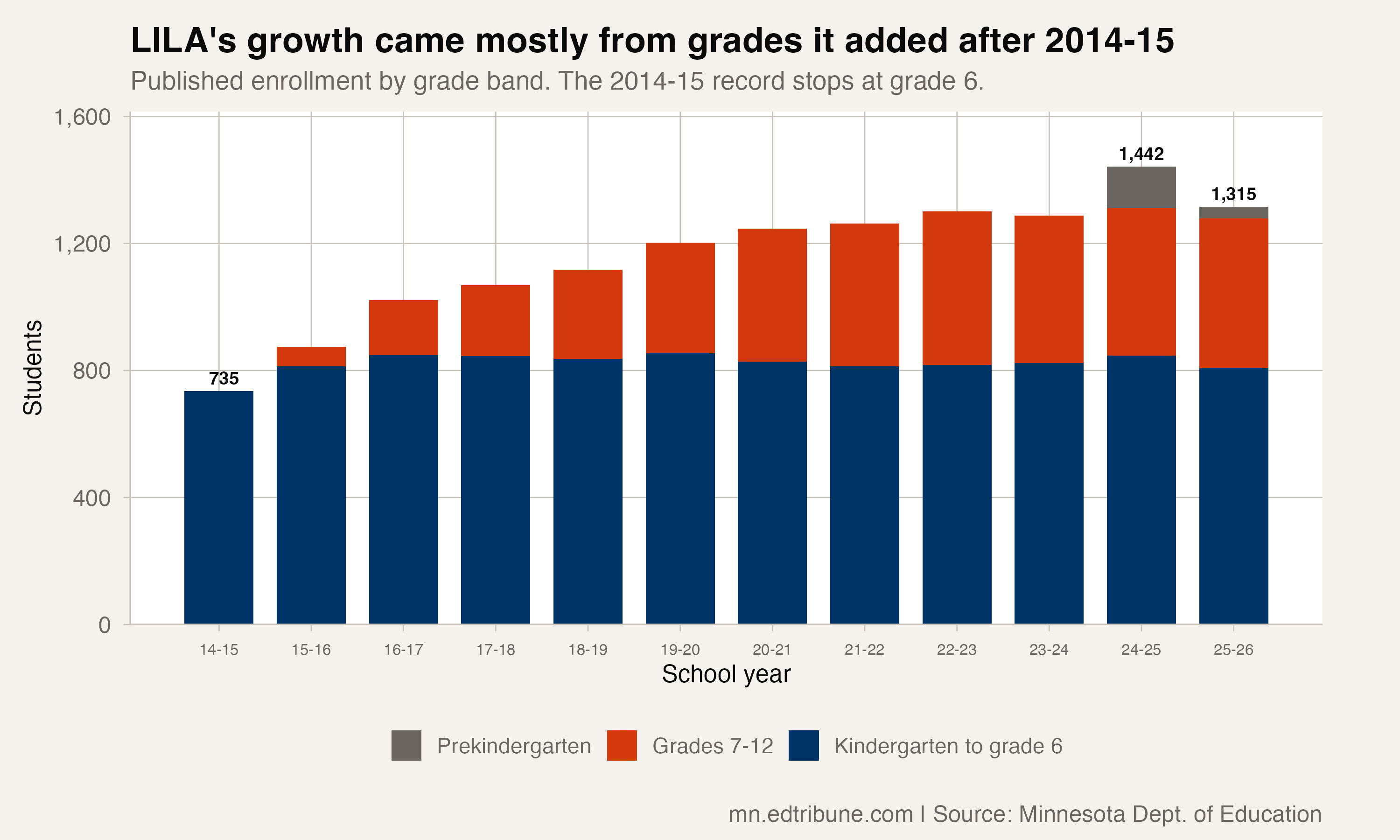
The state now reports LILA in three buildings, and they follow the school's own structure. The Kinder Center, prekindergarten and kindergarten, enrolled 140 students in 2025-26. The Lower School, grades 1 through 5, enrolled 617. The Upper School, grades 6 through 12, enrolled 558.
By total enrollment, LILA ranked 130th of 535 entities in Minnesota's published record in 2025-26 and ninth of 169 charter schools.
Planning around the count
The MNEdTribune's written questions noted that published enrollment rose from 1,263 students in 2021-22 to 1,315 in 2025-26 and asked how that change affects planning. Rasmussen answered in terms of staffing.
"Each year enrollment is a major driver of our planning," she wrote. "Having increased enrollment means that we must look at student needs and programming ensuring that we have all of the right people on board to staff our classrooms and other areas appropriately."
The detail underneath that total is worth separating out. Prekindergarten first appears in LILA's published record in 2024-25, with 131 students, and 36 in 2025-26. Of the 52 students the school added between 2021-22 and 2025-26, 36 were in prekindergarten. Kindergarten through grade 12 enrollment rose by 16 over those years, to 1,279 in 2025-26. The 2024-25 total of 1,442, the highest in the published window, included the first year of prekindergarten.
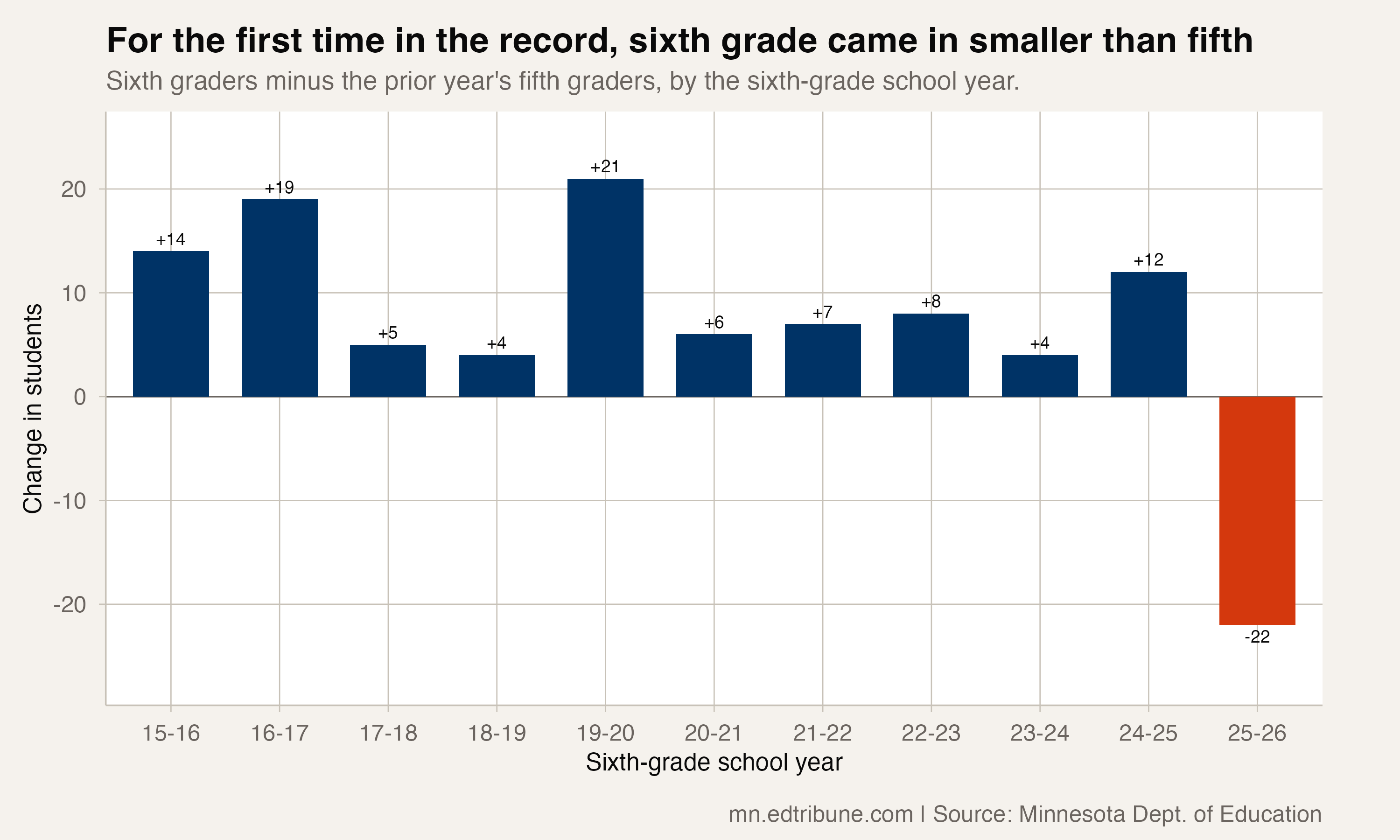
Two grade counts from 2025-26 also stand out. Kindergarten enrolled 104 students, the fewest in any of the 12 published years; the lowest earlier count was 118. And the sixth grade came in smaller than the fifth grade before it: 86 sixth graders in 2025-26, against 108 fifth graders in 2024-25. In each of the 10 earlier year-to-year steps in the record, the sixth-grade class had been larger than the previous year's fifth grade. Sixth grade is the first grade of the Upper School. The enrollment file does not say why either count moved, and one year is not a trend.
Service needs in the record
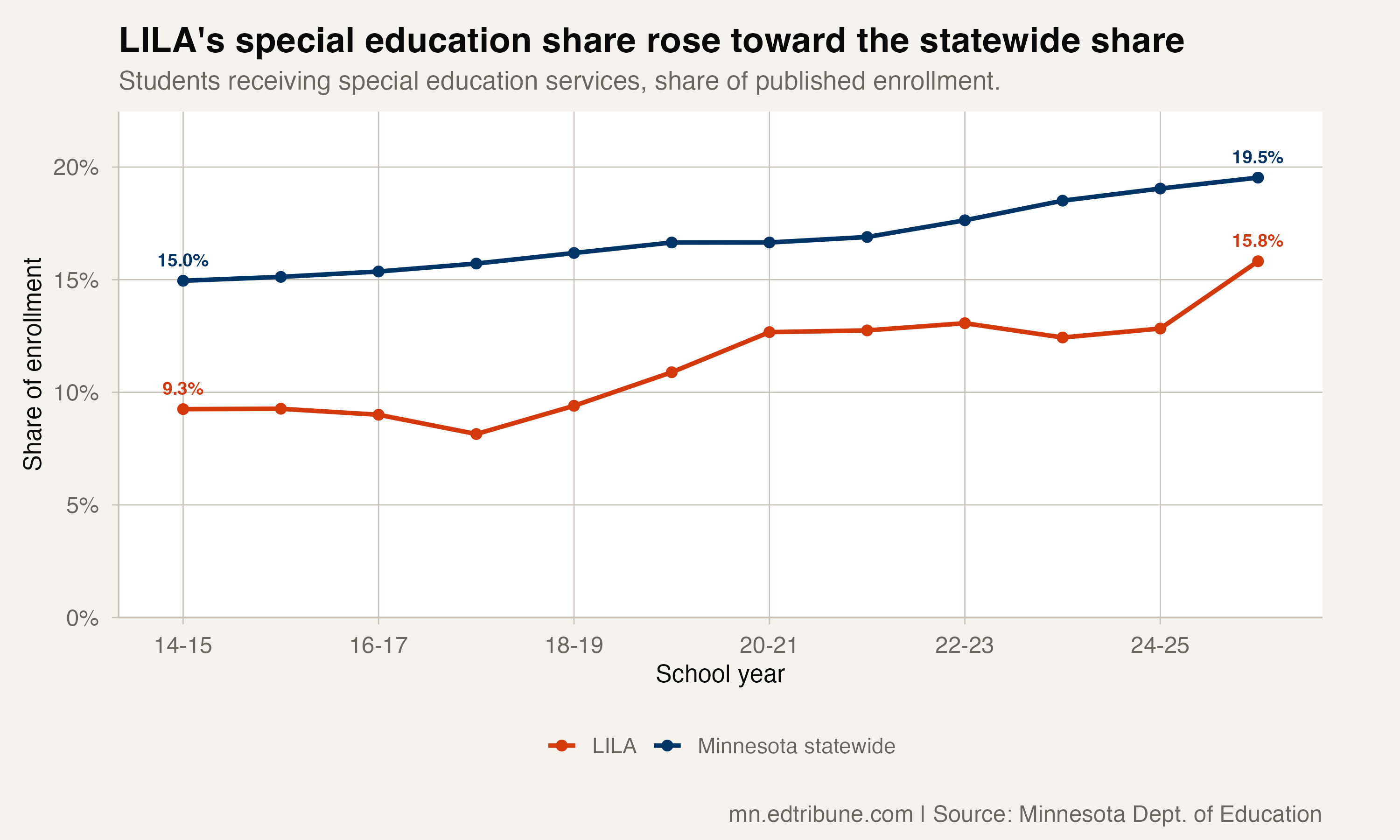
The published record captures one part of what a school's student needs look like: the students it serves through special education. LILA reported 208 students receiving special education services in 2025-26, 15.8 percent of its enrollment, up from 68 students and 9.3 percent in 2014-15. The count roughly tripled while total enrollment grew 78.9 percent. LILA's share stayed below the statewide share in every published year, and the gap narrowed; statewide, 19.5 percent of students received special education services in 2025-26.
The school also reported 78 English learners in 2025-26, 5.9 percent of enrollment. Its published count was zero in each of the first three years of the window.
Rasmussen tied the staffing work back to the school's program. "This allows us to continue delivering a high quality program and experience to all of our students, families and staff," she wrote. The 2026-27 count, the first of her tenure, will show whether the smaller kindergarten and sixth-grade classes carry forward and how the prekindergarten program settles.
Enrollment figures come from the Minnesota Department of Education public enrollment record, covering 2014-15 through 2025-26. Figures are keyed on the school's state identifier and district type rather than its name.
Detailed code that reproduces the analysis and figures in this article is available exclusively to EdTribune subscribers.
Discussion
Sign in to join the discussion.
Loading comments...