The Suburban Donut: Minnetonka Surpasses Robbinsdale
Outer-ring Twin Cities suburbs gained 12,559 students since 2007 while inner-ring districts lost 7,248, reshaping the metro's enrollment geography.
Data-Driven Education Journalism for the North Star State
Education News & Data
Local education reporting from every corner of Minnesota, grounded in Minnesota Department of Education data.
Hastings is the only Minnesota district to decline every single year in the state's dataset. The 19-year streak has erased 1,118 students, 22% of enrollment.
Minnesota lost 130,507 white students since 2007 while every other racial group grew. White decline exceeds the state's entire net enrollment change.
A virtual campus run by Pearson now enrolls more students than any brick-and-mortar school in Minnesota. Online enrollment has tripled since COVID.
Black enrollment in Minneapolis Public Schools has fallen 47% since 2007, while white share rose from 28.5% to 36.4%. The shift is not gentrification adding students. It is Black and Asian families leaving faster.
Outer-ring Twin Cities suburbs gained 12,559 students since 2007 while inner-ring districts lost 7,248, reshaping the metro's enrollment geography.
Nearly one in five Minnesota students now receives special education services, up from one in seven in 2014, straining budgets despite a historic state funding increase.
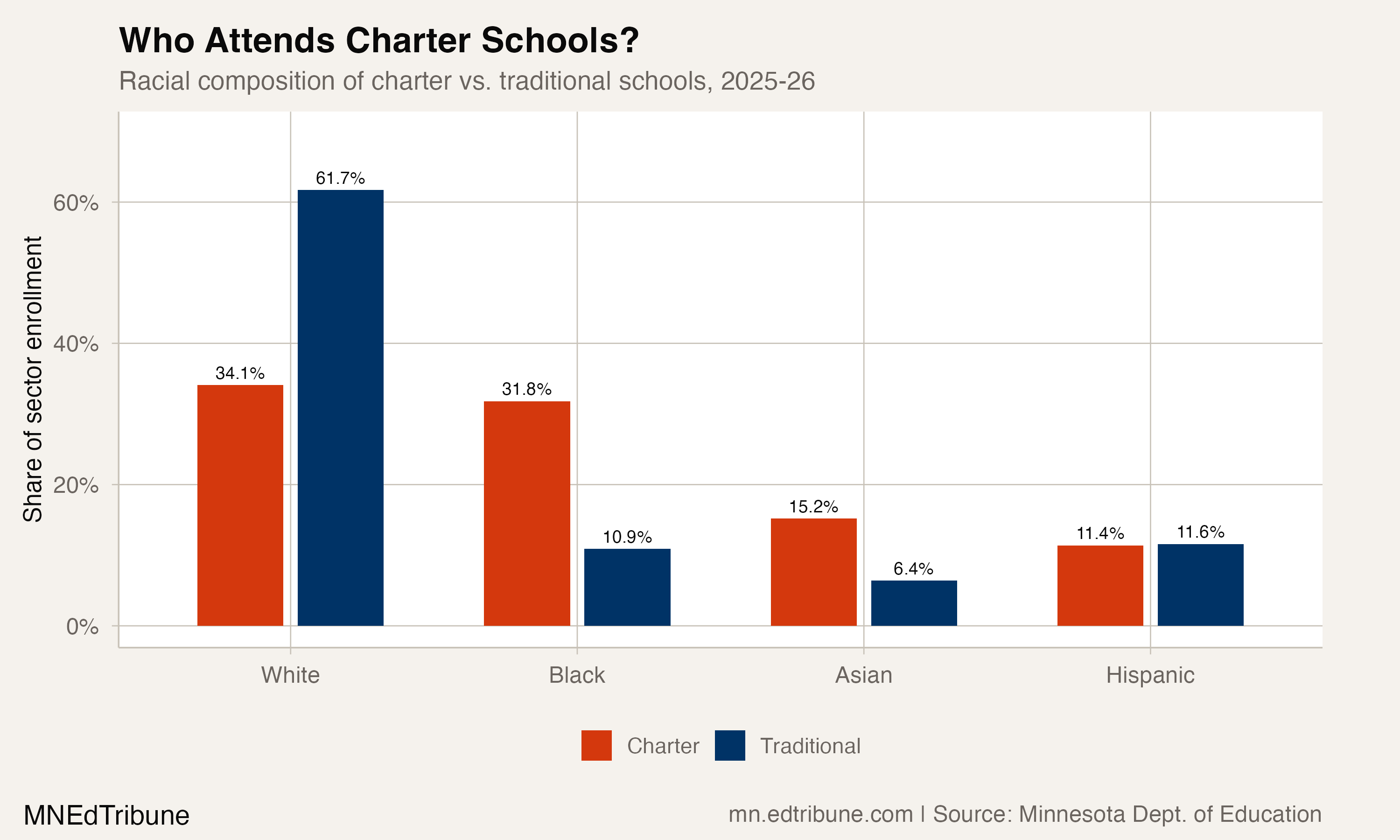
The state that invented charter schools 35 years ago saw its charter share stall at 8.3% in 2025-26, even as 76 of the 245 charters ever opened have closed.
St. Cloud's Black enrollment surged from 12% to 43% in 20 years, driven by Somali resettlement. The district now has more Black students than white.
Minnesota lost 23,236 students between 2020 and 2024. Five years later, only 3,208 have returned, a 13.8% recovery rate that masks a deeper structural shift.
After 18 straight years of growth that doubled their numbers, Hispanic students in Minnesota declined by 137 in 2025-26.
MDE releases 2025-26 enrollment data showing 873,175 students statewide, 3,208 above the post-COVID trough, with a 13.8% recovery rate.