In this series: Minnesota 2025-26 Enrollment.
In 2006-07, St. Cloud↗ET enrolled 9,557 students. Nearly four out of five were white. Black students made up 12.1% of the district, a small minority in a city that had been overwhelmingly Scandinavian and German for generations.
By 2025-26, the numbers had inverted. Black students are now 43.0% of enrollment, the largest group in the district. White students have dropped to 33.8%. The total enrollment barely changed: 10,232 students, just 675 more than 20 years ago. But the composition of those classrooms is unrecognizable.
No mid-size district in Minnesota has undergone a transformation this fast. St. Cloud's Black enrollment share is 3.4 times the statewide average of 12.6%, and it exceeds Minneapolis, where Black students make up 26.8% of enrollment. The shift was driven overwhelmingly by one community: Somali refugees and their American-born children, who began arriving in Central Minnesota at the turn of the century and have reshaped the district's identity, its budget, and its politics.
The Crossover
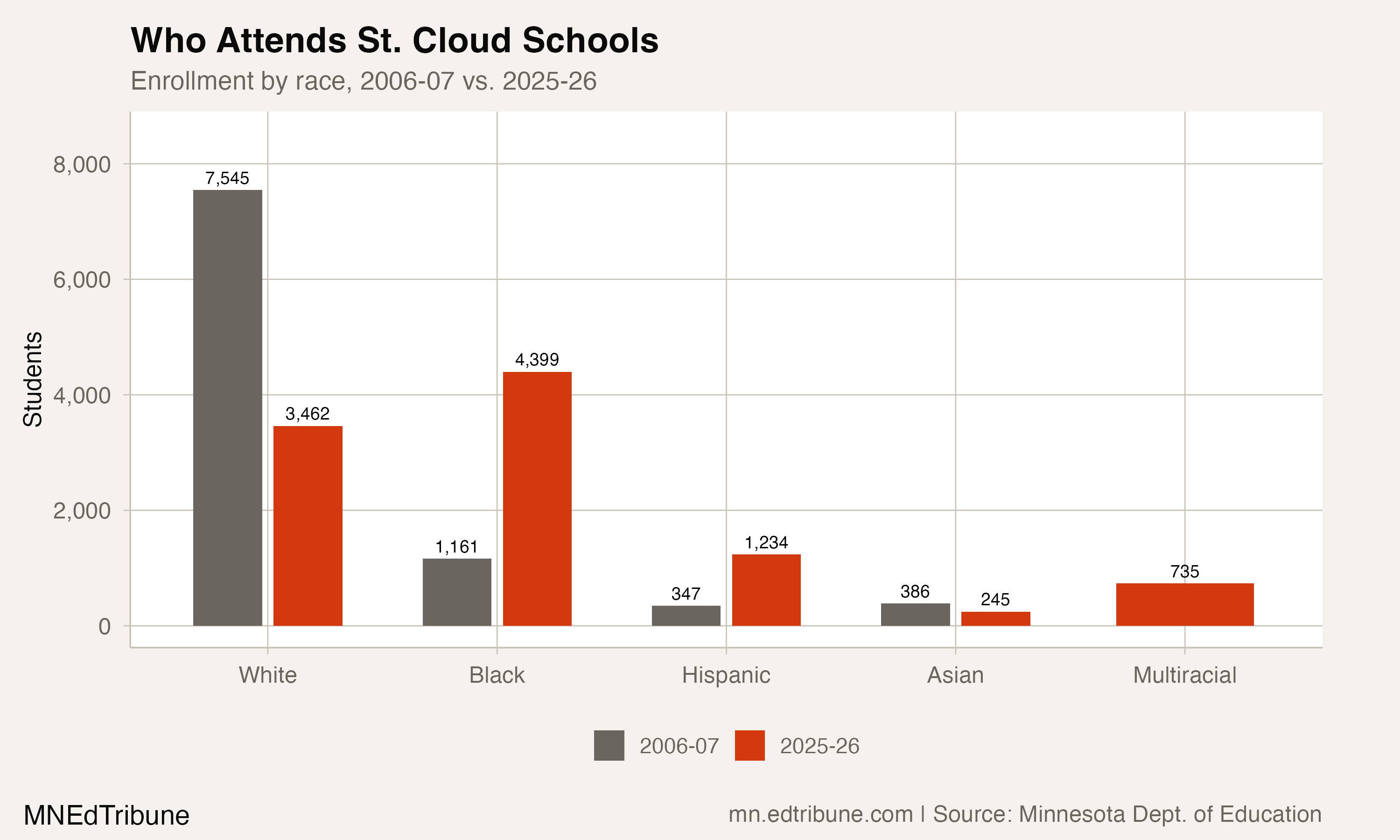
The trend lines crossed in 2021, when Black enrollment share (41.4%) surpassed white enrollment share (40.5%) for the first time. That crossover was the culmination of two decades of steady, compounding change: Black enrollment grew from 1,161 students in 2006-07 to 4,399 in 2025-26, an increase of 279%. White enrollment fell from 7,545 to 3,462, a decline of 54.1%.
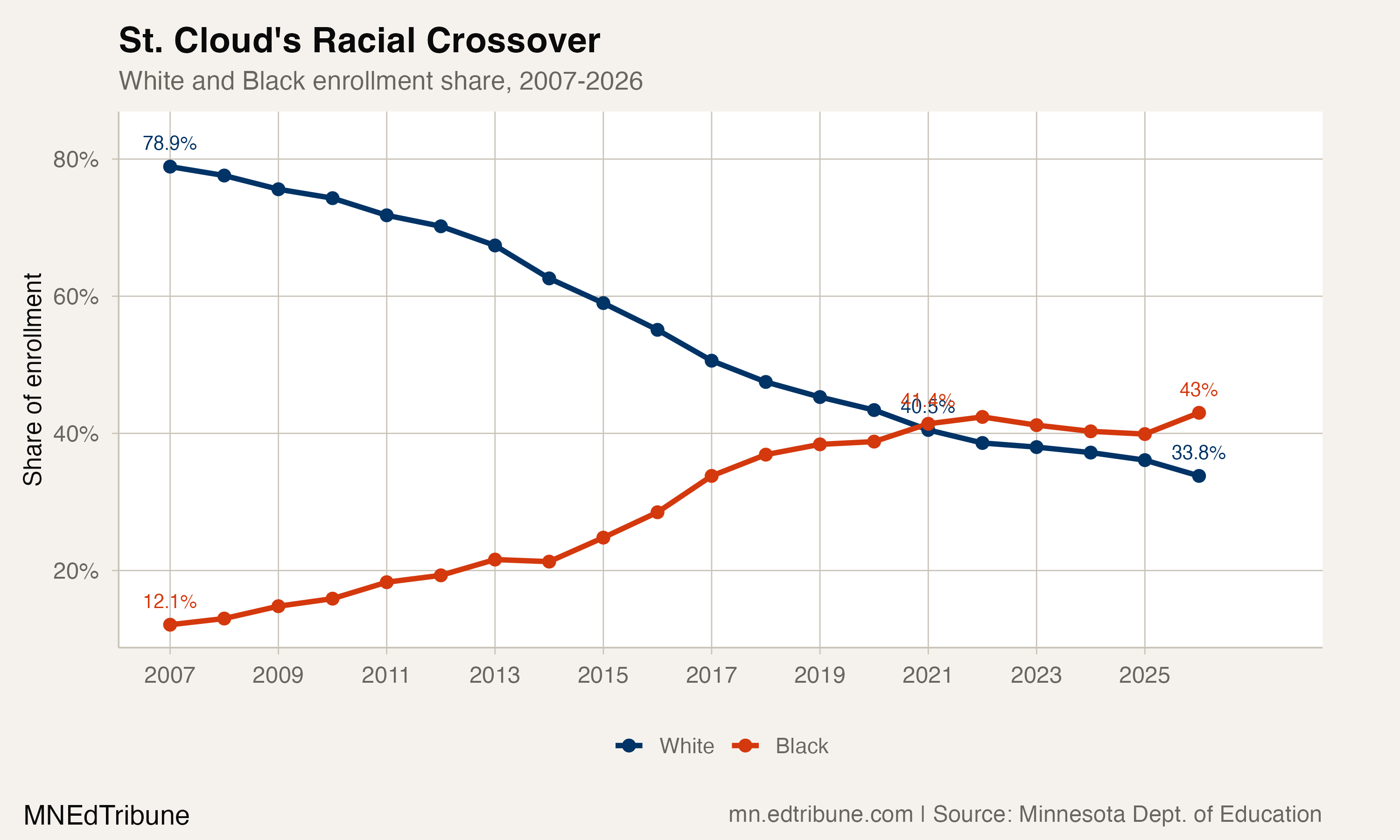
St. Cloud became majority-minority in 2018, when the white share dropped below 50% for the first time. It has fallen every year since. Meanwhile, the district's Hispanic population has grown 256%, from 347 students to 1,234, making Hispanic students 12.1% of enrollment in 2025-26, up from 3.6% in 2006-07.
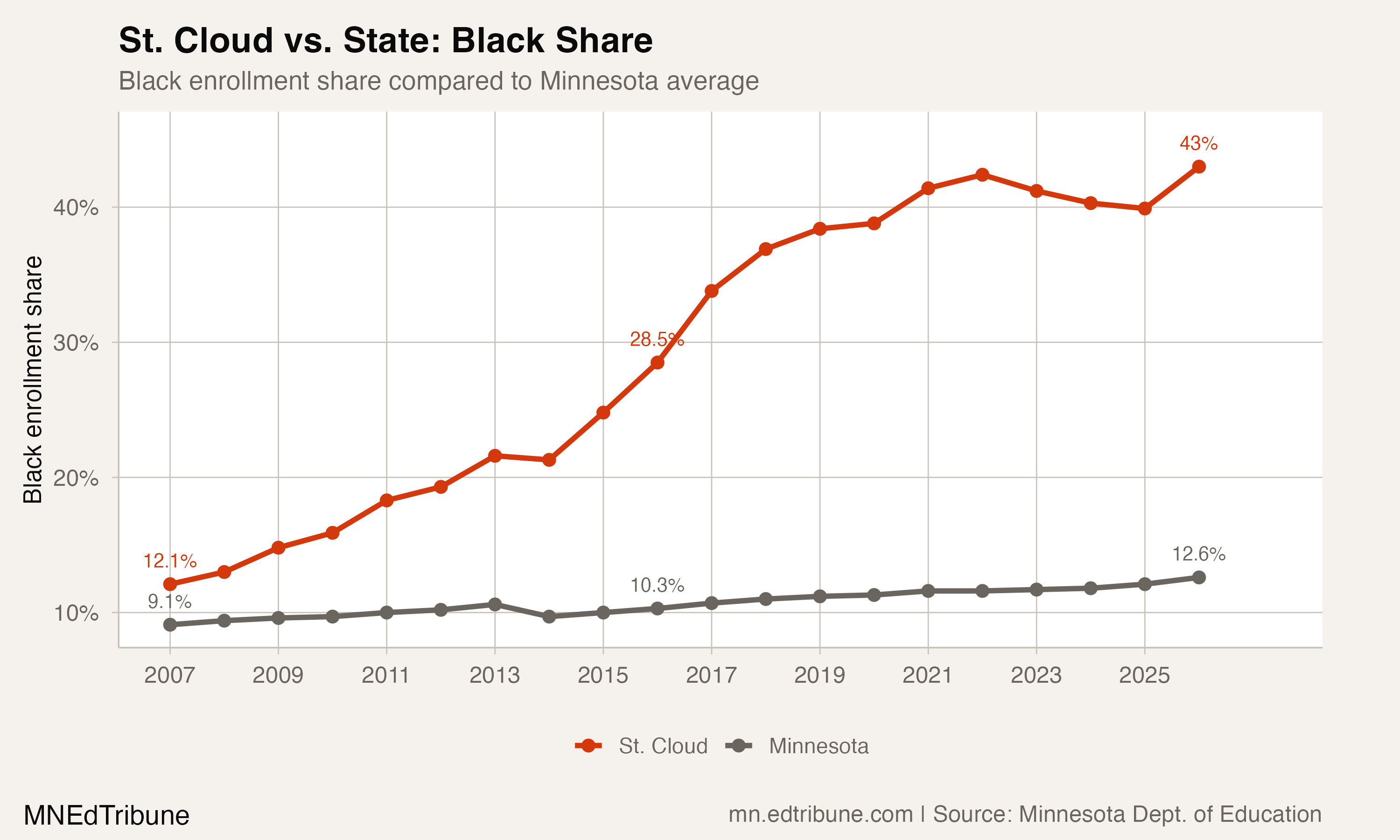
The district's demographic profile now looks nothing like the state it sits in. Statewide, Minnesota's Black enrollment share crept from 9.1% to 12.6% over the same period. St. Cloud's share grew more than 30 percentage points. The gap between St. Cloud and the state average widened from 3 points in 2007 to more than 30 points by 2026.
Somali Resettlement and the Remaking of Central Minnesota
The mechanism behind St. Cloud's transformation is not ambiguous. Somali families began resettling in the St. Cloud area through federal refugee programs around 2000, drawn by resettlement agencies operating in the region, affordable housing, and meatpacking and manufacturing jobs. Secondary migration from initial placements in other states, particularly New York and Texas, amplified the flow.
By 2020, St. Cloud's city-wide Black population had reached nearly 15,000, up from approximately 1,700 in 2000. Nearly 4,400 St. Cloud residents claim Somali heritage. Statewide, approximately 107,000 people of Somali descent live in Minnesota, the largest Somali community in the United States. Nearly 58% were born in the U.S.
The school enrollment data captures something the census underestimates. Because Somali families tend to be young, with 47.1% of Minnesota's Somali population under 17, their share of the school-age population far outpaces their share of the general population. The city's overall Black population is roughly 20% according to the 2020 Census; in the schools, it is 43%.
"I think the first thing people do when they get their citizenship is to vote." — Ahmed Abdi, journalist, on Somali civic engagement in St. Cloud, MPR News, Oct. 2024
The community's growing civic presence extends beyond the classroom. Multiple Somali-American candidates have run for city council and state legislative seats, and political scientist Matt Lindstrom has observed that two decades of settlement have given the community "more capital, both financial and social capital" to engage politically.
One in Four Students Is an English Learner
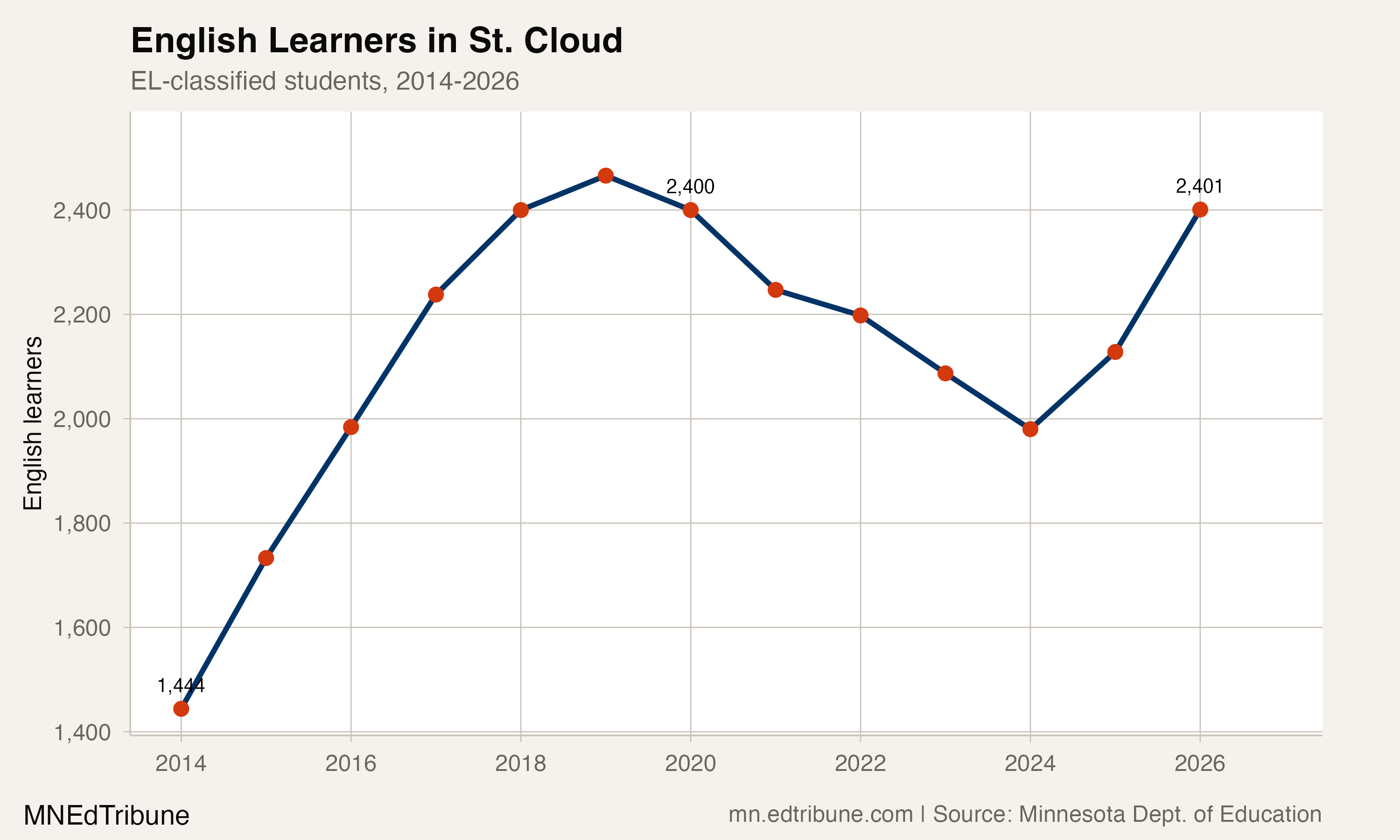
The demographic shift created a parallel operational challenge: language services. In 2025-26, 2,401 students in St. Cloud were classified as English learners, 23.5% of total enrollment. That is nearly double the statewide average. The EL population grew 66% from 1,444 in 2014, peaked at 2,466 in 2019, dipped during the pandemic years, and has now returned to its pre-COVID level.
The operational weight of that concentration falls on specific schools. PBS NewsHour reported that at Talahi Elementary, roughly 45% of students are Somali, and at Apollo High School, nearly a quarter of 1,400 students are Somali. Out of more than 700 teachers in the district, only one is Somali.
The district has responded with programmatic innovation. St. Cloud launched Minnesota's first Somali language immersion program for incoming kindergarteners. The dual immersion model splits the school day between Somali and English instruction across all subjects. Abdi Mahad, who created the elementary curriculum, has noted that many Somali-American students speak Somali at home but cannot read or write it.
"Research shows that kids who learn to first read and write their native language gain the skills to better acquire a second language." — Abdi Mahad, curriculum designer, Mpls.St.Paul Magazine
The Funding Gap Behind the Numbers
St. Cloud's transformation has not come with matching resources. The district ranks as Minnesota's least adequately funded, receiving approximately 66% of needed state support according to a 2023 MPR analysis. With 70% of students qualifying for free or reduced-price lunch and nearly 25% receiving special education services, the district's cost structure reflects a student body with intensive needs.
Special education enrollment has risen steadily, from 20.0% of the student body in 2014 to 24.9% in 2025-26. One in four St. Cloud students now receives special education services. (EL and special education populations overlap substantially; these figures should not be added together.) Finance director Amy Skaalerud has described the district's special education and English learner services as generating "large cross subsidies that are underfunded" at both state and federal levels.
In 2025, federal funding uncertainty compounded the pressure. The district was waiting on more than $1 million in federal grants, including $250,000 in Title III funds specifically earmarked for English learner support.
Growing, Not Shrinking
St. Cloud's demographic story is unusual in another respect: total enrollment has held steady and recently grown. Most Minnesota districts are shrinking. The state lost 20,028 students between 2020 and 2026. St. Cloud gained 61 over that span, and in the last two years it has surged: enrollment jumped from 9,286 in 2022-23 to 10,232 in 2025-26, an increase of 946 students. Board member Al Dahlgren told St. Cloud Live that in his 13 years on the board, he had not seen anything like the recent growth.
The growth is driven entirely by students of color. White enrollment fell by 68 students between 2022-23 and 2025-26. Black enrollment grew by 577, Hispanic by 376, and multiracial by 49.
District officials noted that over 400 students transferred in from charter schools or other districts in the most recent year.
No Comparable Peer
Among Minnesota's mid-size districts, no peer comes close to St. Cloud's demographic profile. Rochester, the state's third-largest district, has a Black enrollment share of 17.2%. Moorhead sits at 16.6%, Mankato at 14.5%, and Willmar at 14.2%. St. Cloud's 43.0% is in a category by itself.
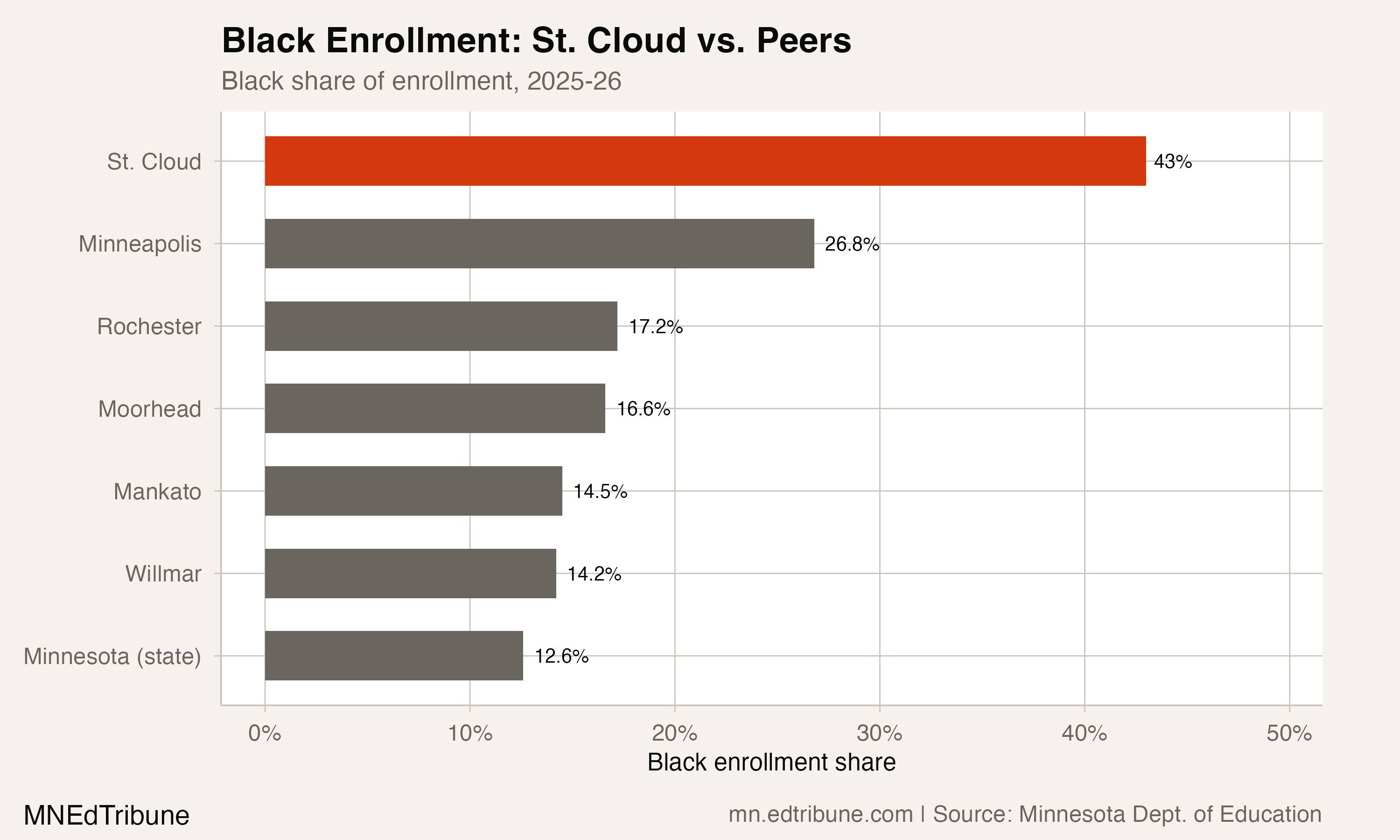
Even Minneapolis, the state's largest and most diverse urban district, enrolls a smaller share of Black students at 26.8%. St. Cloud, a city of 69,000 an hour northwest of the Twin Cities, has a higher concentration of Black students than any other traditional school district in Minnesota.
The district's 2026-29 achievement plan reflects the stakes. Graduation rates for Black students stood at 65.4% in 2024. For Hispanic students, the rate was 43.8%. Third-grade reading proficiency for Black students was 43%, and for Hispanic students, 12.1%. The district has set a goal of 85% graduation rates for underrepresented groups by 2029.
The teacher gap
The question for St. Cloud is whether the infrastructure catches up to the students. The district has grown more diverse than any comparable community in Minnesota, but its teacher workforce remains 91.5% white. Federal funding for EL services is uncertain. Special education cross-subsidies are growing. And a community that has experienced documented tensions around demographic change is now at a point where the plurality group in the schools is the population that arrived most recently.
The 2026-27 kindergarten cohort will provide the next signal. If the recent pattern holds, with 1,000 students enrolling for the first time in the most recent year alone, St. Cloud's total enrollment will push toward levels not seen since the mid-2010s, even as it continues losing white students.
Meanwhile, at an elementary school in St. Cloud, a class of kindergarteners is learning to read and write in Somali before switching to English after lunch. The dual immersion program, the first of its kind in Minnesota, is built on a simple premise from curriculum designer Abdi Mahad: children who are literate in their home language learn a second language faster. It is the kind of program that only exists in a district where 43% of students are Black, where 2,401 are learning English, and where one Somali teacher serves a workforce of more than 700.
Detailed code that reproduces the analysis and figures in this article is available exclusively to EdTribune subscribers.
Discussion
Sign in to join the discussion.
Loading comments...