In this series: Minnesota 2025-26 Enrollment.
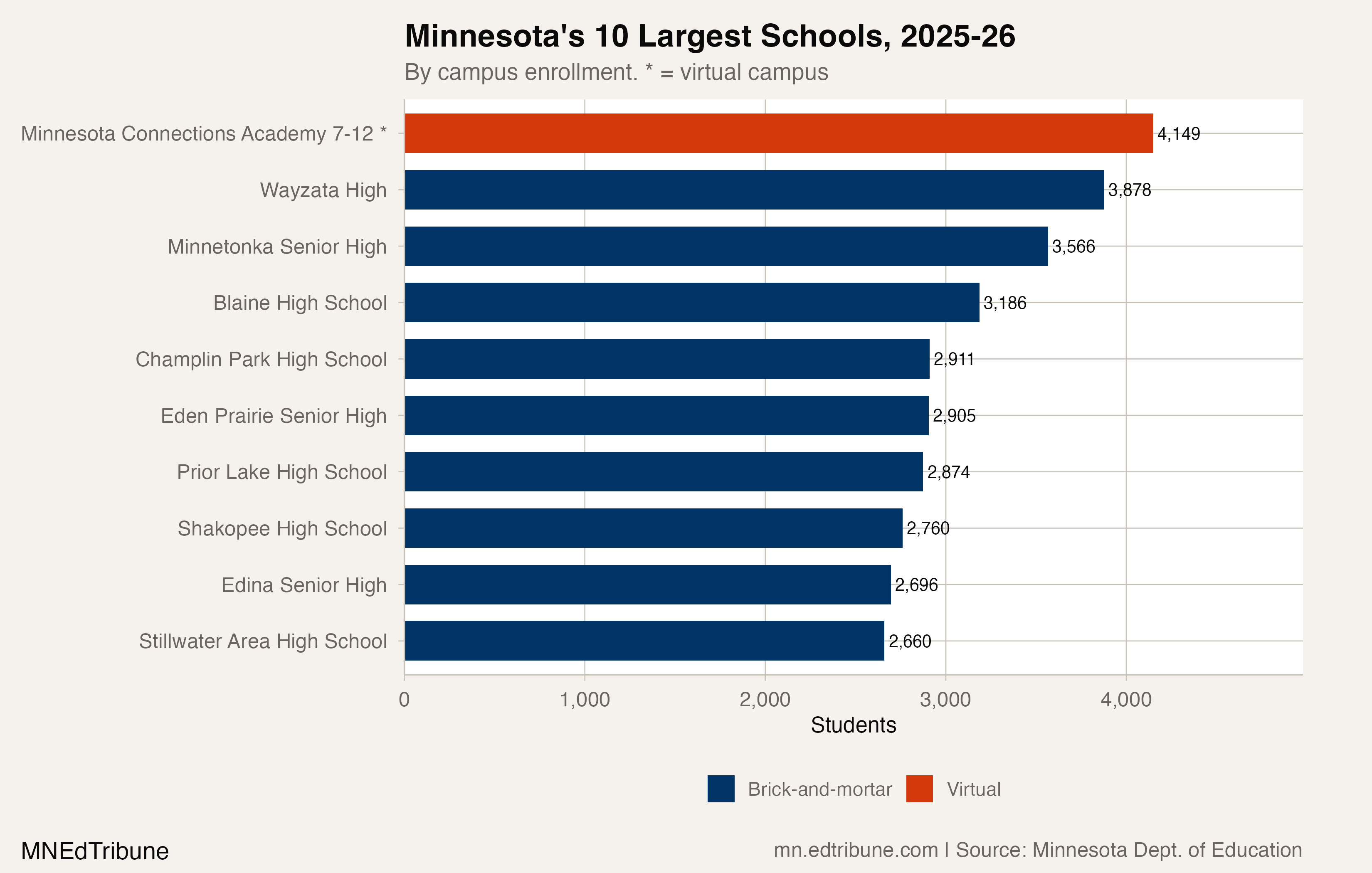
The largest school in Minnesota does not have a gymnasium, a cafeteria, or a parking lot. Minnesota Connections Academy 7-12, a virtual campus operated by Pearson under the charter umbrella of Minnesota Transitions Charter School↗ET, enrolled 4,149 students in 2025-26. That is 271 more than Wayzata↗ET High School, the state's largest brick-and-mortar campus at 3,878.
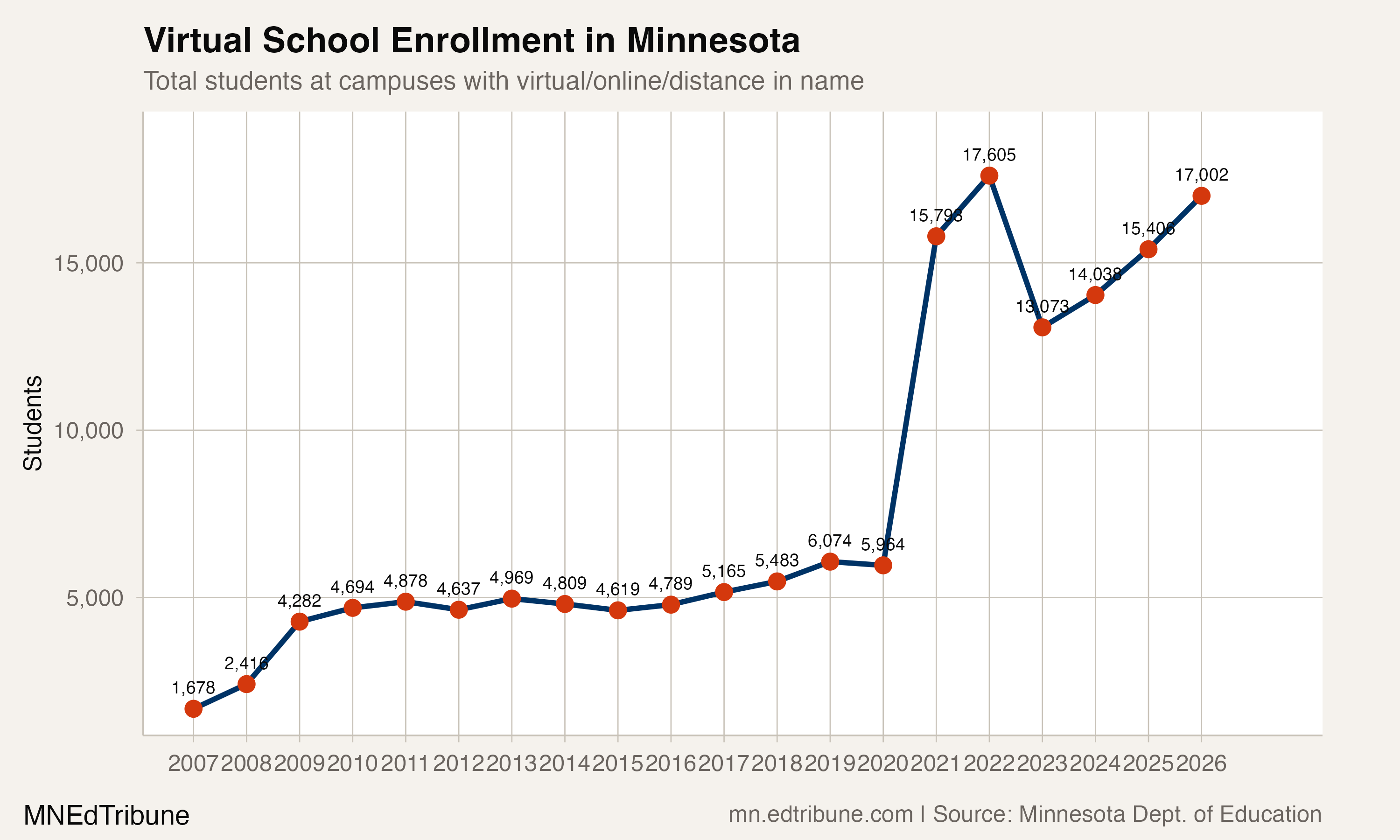
A virtual school outranking every traditional high school in the state was far from anyone's forecast five years ago. In 2019-20, Minnesota's identifiable virtual campuses enrolled fewer than 6,000 students total, roughly 0.7% of the state's public school population. By 2025-26, that figure had nearly tripled to 17,002 students across 105 campuses, or 1.9% of statewide enrollment. The pandemic accelerated a shift that shows no sign of reversing.
One charter, 92% virtual
The story of virtual schooling in Minnesota runs through one organization. Minnesota Transitions Charter School, which describes itself as "the largest group of charter schools in the state," operates seven school programs: five brick-and-mortar campuses in the Twin Cities and two online programs, including the Connections Academy franchise operated by Pearson.
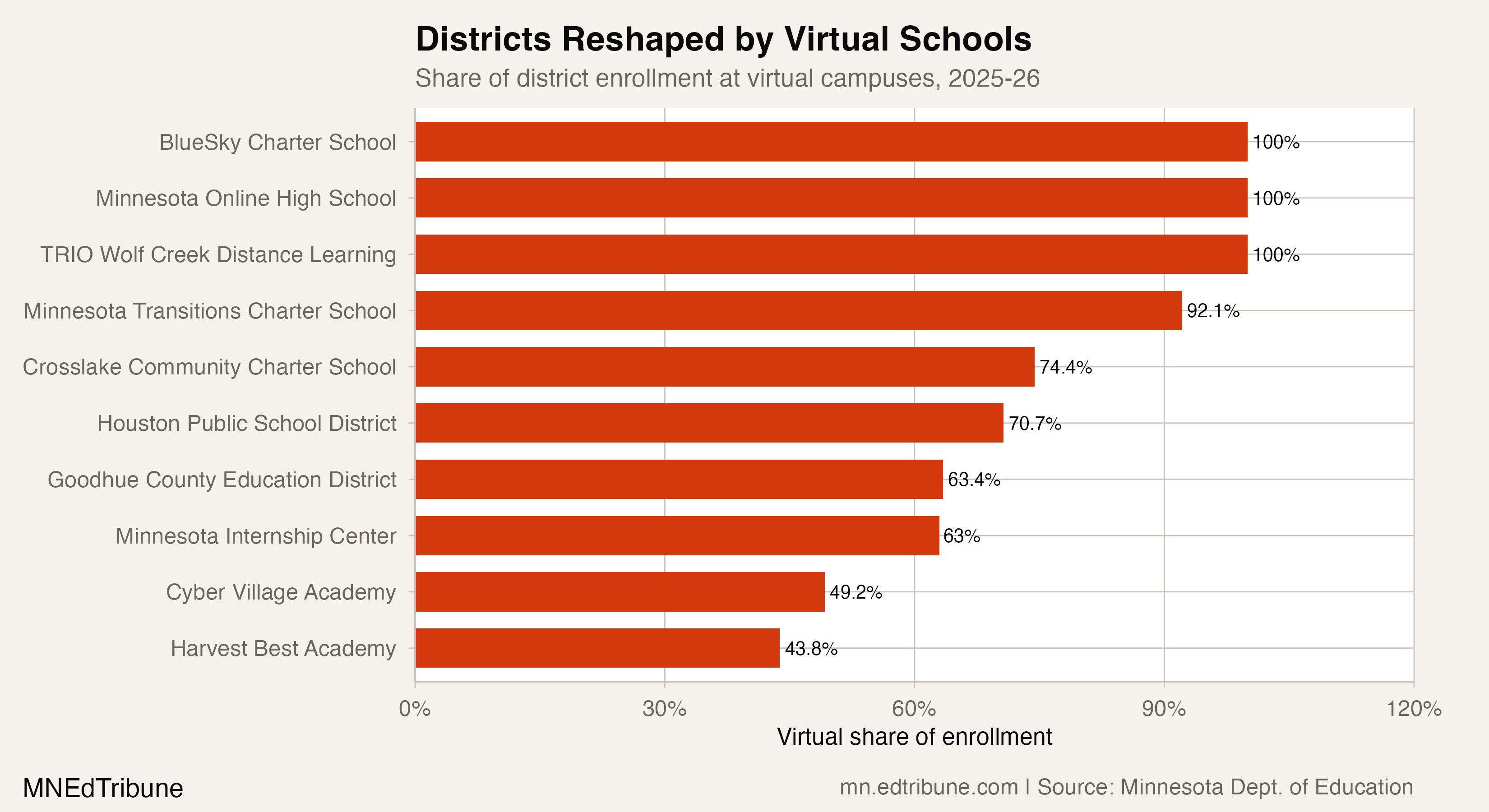
In 2025-26, MTCS enrolled 6,425 students. Of those, 5,915, or 92.1%, attended a virtual campus. The five physical schools combined enrolled just 510 students. MTCS has effectively become a virtual school operator that happens to maintain a handful of small physical sites.
The growth has been steep. MTCS enrolled 3,593 students in 2019-20. By 2020-21, the first full pandemic year, that jumped to 5,508, a 53.3% increase in a single year. After a slight dip in 2022 and 2023, enrollment surged again: 5,682 in 2024-25 and 6,425 in 2025-26, a 78.8% increase over pre-pandemic levels.
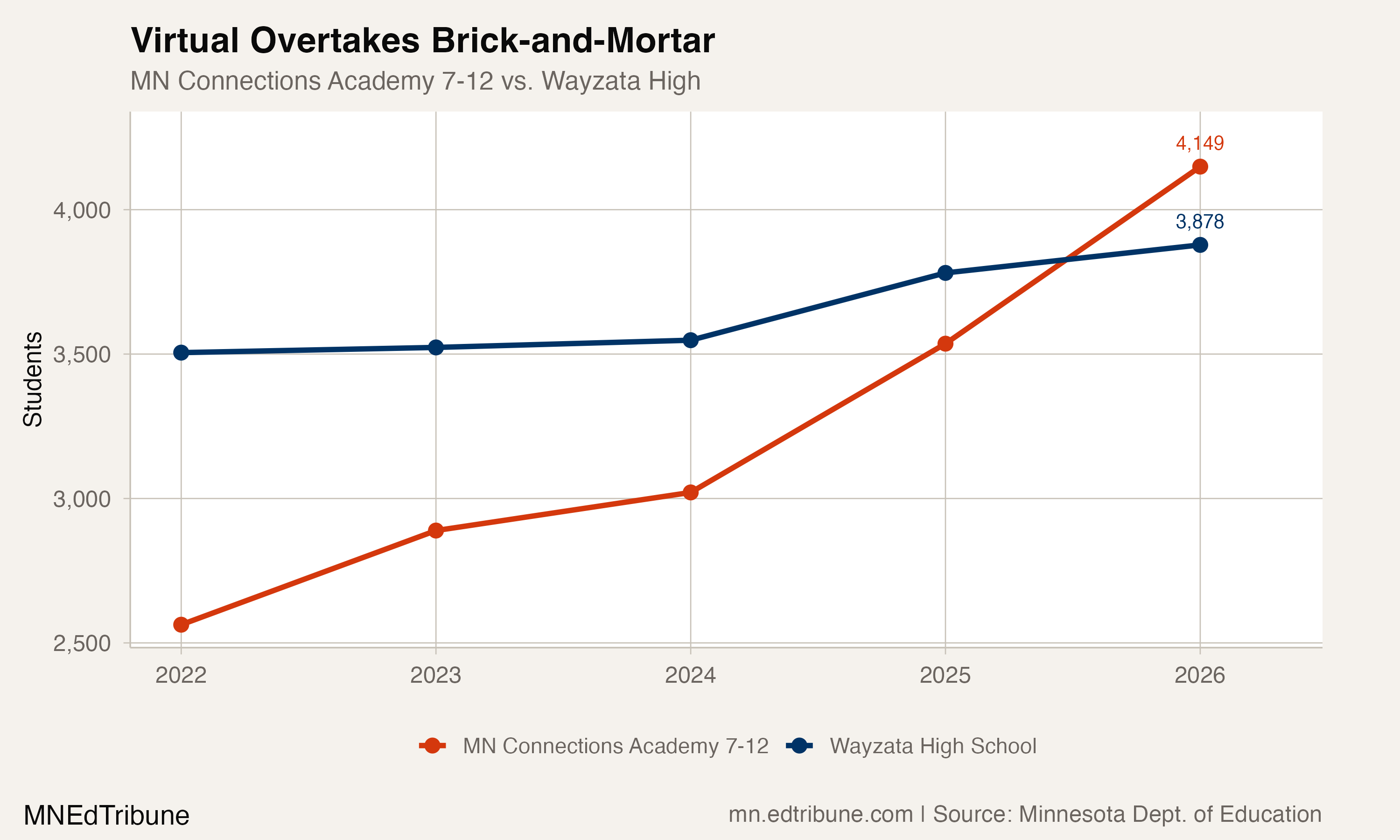
Within MTCS, the Connections Academy 7-12 campus has grown the fastest. Since the campus was first reported under that name in 2021-22, its enrollment has risen from 2,563 to 4,149, a 61.9% increase in four years.
The COVID ratchet
Virtual enrollment in Minnesota followed a pattern documented nationally by The 74: it spiked during the pandemic, partially retreated, then resumed climbing. Minnesota was one of six states with consecutive year-over-year increases in virtual enrollment during both 2020-21 and 2021-22.
"It looks like it'll stick. In some states, the numbers went up temporarily and came back down a bit. But overall, if families are staying for a couple of years, I would expect that they would keep it going." -- Robin Lake, Center on Reinventing Public Education, via The 74
The statewide data bears this out. Virtual campuses enrolled 5,964 students in 2019-20 across 16 campuses. By 2020-21, enrollment nearly tripled to 15,793 across 23 campuses. It peaked at 17,605 in 2021-22, dipped to 13,073 in 2022-23 as schools fully reopened, then climbed back to 17,002 in 2025-26. The number of virtual campuses, meanwhile, exploded from 16 in 2019-20 to 105 in 2025-26, as dozens of traditional districts launched their own online programs.
Rural districts as virtual hosts
The virtual school phenomenon has transformed at least one small rural district into something unrecognizable in headcount terms. Houston↗ET Public School District, a district of 1,827 students in southeastern Minnesota, hosts the Minnesota Virtual Academy, a statewide online program operated by Stride (formerly K12 Inc.). MNVA's three virtual campuses enrolled 1,291 students in 2025-26, or 70.7% of the district's total campus enrollment. Houston's physical sites, including Houston Elementary (228 students), Houston Secondary (223), and a Summit Learning Program (85), together enrolled 536 students.
This arrangement means that the per-pupil funding attached to roughly 1,300 students statewide flows through a rural district with 536 in-person students. Minnesota's general education formula allowance is $7,281 per pupil for 2024-25, which means MNVA generates approximately $9.4 million in basic formula revenue for Houston PSD.
Houston is not unique. Crosslake Community Charter School derives 74.4% of its enrollment from virtual campuses. Goodhue County Education District draws 63.4% from online programs. Across Minnesota, 66 districts and charter organizations now operate at least one virtual campus.
Who operates virtual schools
The split between charter and traditional district virtual programs is nearly even in student headcount, but the structure is strikingly different. Charter-authorized virtual campuses enrolled 8,810 students across 27 campuses in 2025-26, an average of 326 students per campus. Traditional district online programs enrolled 8,192 students across 78 campuses, averaging 105 per campus.
The charter side is dominated by two large operators. MTCS (through Connections Academy and MN Virtual Schools) accounts for 5,915 virtual students. BlueSky Charter School, a fully virtual charter, enrolls 655. Together, these two organizations represent 74.6% of all charter-sector virtual enrollment.
On the traditional side, the picture is fragmented. Most of the 78 district-run virtual campuses are small: the median enrolls 62 students, and a quarter enroll fewer than 27. They tend to serve as supplemental programs for families who want partial online options, not as stand-alone schools. The major exception is Houston PSD's Minnesota Virtual Academy, a full-time statewide program with 1,291 students.
Accountability in a virtual sector
The enrollment data shows where students are counted. It does not show whether they are learning. Connections Academy is operated nationally by Pearson, the London-based education conglomerate. The virtual franchise model, in which a for-profit company provides curriculum and platform while a local charter holds the public enrollment, has drawn scrutiny in multiple states over questions of instructional quality and public accountability.
Minnesota Transitions Charter School is authorized by Pillsbury United Communities, a Minneapolis-based nonprofit. The authorizer's role is to evaluate the school's performance and determine whether to renew its charter. Whether that evaluation framework, designed when MTCS was a small alternative charter, is adequate for a 6,425-student operation that is 92% virtual is a question the enrollment data alone cannot address.
The operational question is also significant. When a single virtual campus enrolls 4,149 students, it is not a school in any sense that Wayzata High or Minnetonka↗ET Senior High (3,566 students) would recognize. The student-teacher interactions, the community connections, the extracurricular infrastructure differ fundamentally. Whether a per-pupil funding model designed for physical schools appropriately compensates virtual instruction is a policy question that Minnesota has not resolved.
A permanent feature
Virtual enrollment of 17,002 students nearly matches the all-time high set in 2021-22 (17,605), reached without any pandemic-era emergency. The number of virtual campuses, at 105, is itself an all-time high. One in every 51 Minnesota students now attends a school with no hallways, no lockers, and no lunch period. The largest single campus in the state has never held a graduation on a football field.
Detailed code that reproduces the analysis and figures in this article is available exclusively to EdTribune subscribers.
Discussion
Sign in to join the discussion.
Loading comments...