In this series: Minnesota 2025-26 Enrollment.
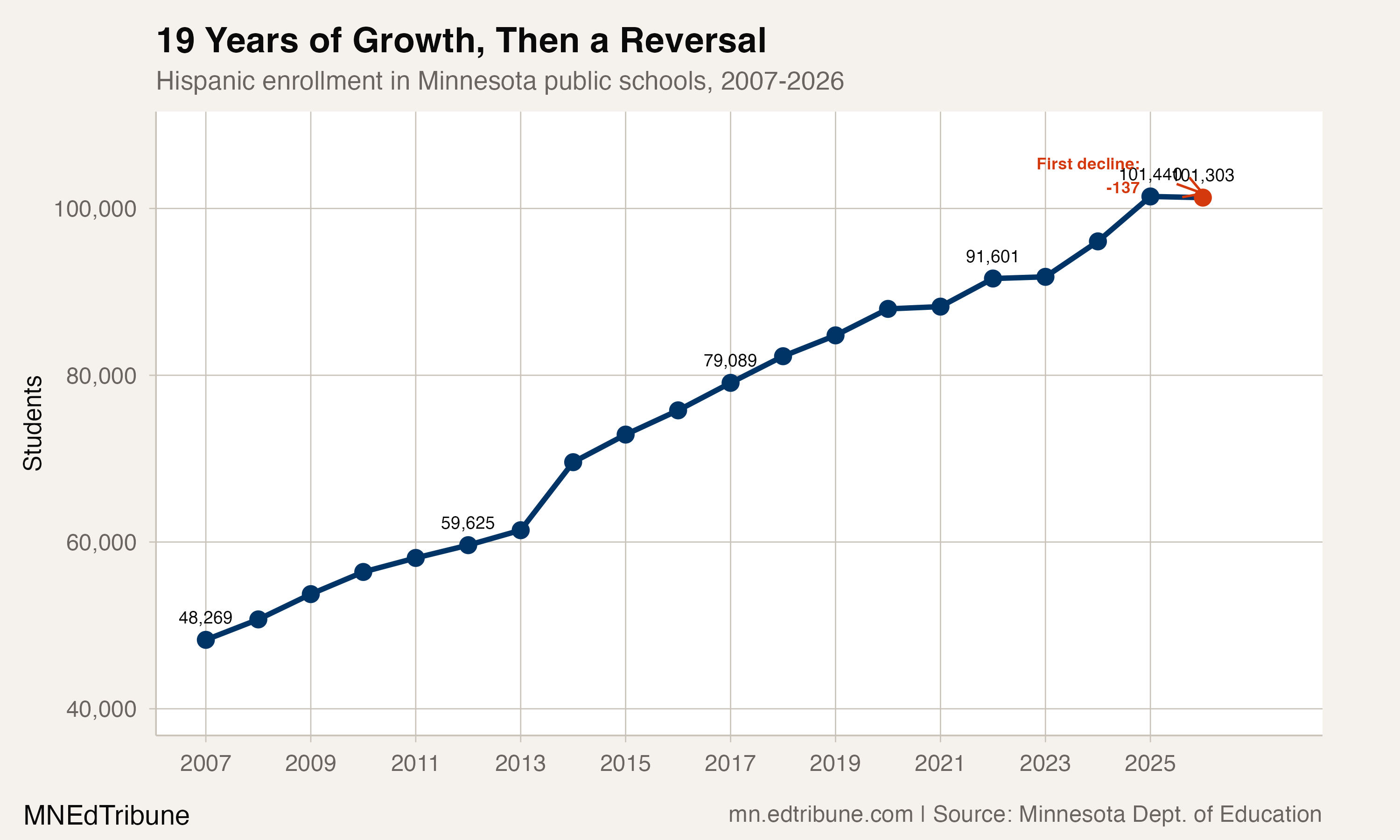
For 18 consecutive years, Hispanic enrollment in Minnesota moved in one direction. From 48,269 students in 2006-07 to 101,440 in 2024-25, the growth never paused, not even during the pandemic. No other demographic group in the state came close to that streak.
In 2025-26, it ended. Hispanic enrollment fell by 137 students to 101,303, a decline of 0.1%. The number is small. The signal is not.
The arithmetic of a plateau
The raw decline of 137 students is barely a rounding error in a state enrolling 873,175 children. But context matters: Hispanic students had been adding an average of 2,800 per year over the prior decade. They more than doubled from 48,269 to 101,440 between 2007 and 2025, a gain of 110.2%. Their share of total enrollment climbed from 5.7% to 11.6% over the same period.
That growth had already been uneven. The year-over-year pattern shows a volatile trajectory: gains of just 270 in 2020-21 and 201 in 2022-23 sandwiched between years adding 3,000 or more. Then came two unusually large jumps, 4,253 in 2023-24 and 5,385 in 2024-25, before the reversal.
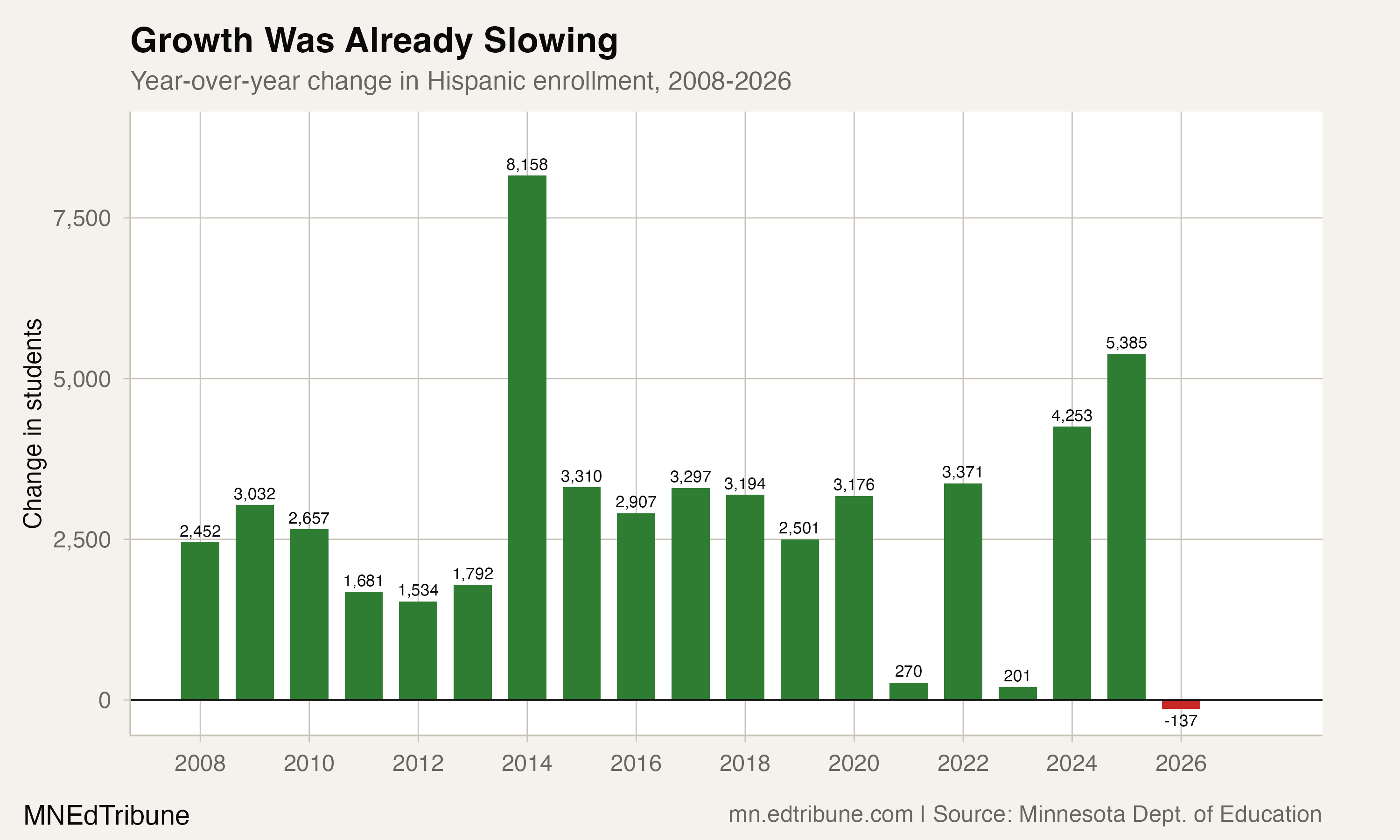
The 2014 spike of 8,158 deserves scrutiny. That anomalous one-year jump, triple the typical annual gain, likely reflects a reclassification or reporting change rather than an actual surge in arrivals. Growth before and after 2014 was remarkably steady at 2,000 to 3,300 per year.
Not a Hispanic story alone
Hispanic students are not the only group losing ground. White enrollment fell by 9,201 in 2025-26, continuing a long structural decline that has erased 130,507 white students since 2007, a drop of 20.1%. What makes the Hispanic decline distinctive is that it breaks a pattern no other group matched. Black enrollment rose by 3,933. Multiracial students grew by 1,007. Native American enrollment increased by 528, and Asian by 189. Hispanic students were the only previously growing group to reverse direction.
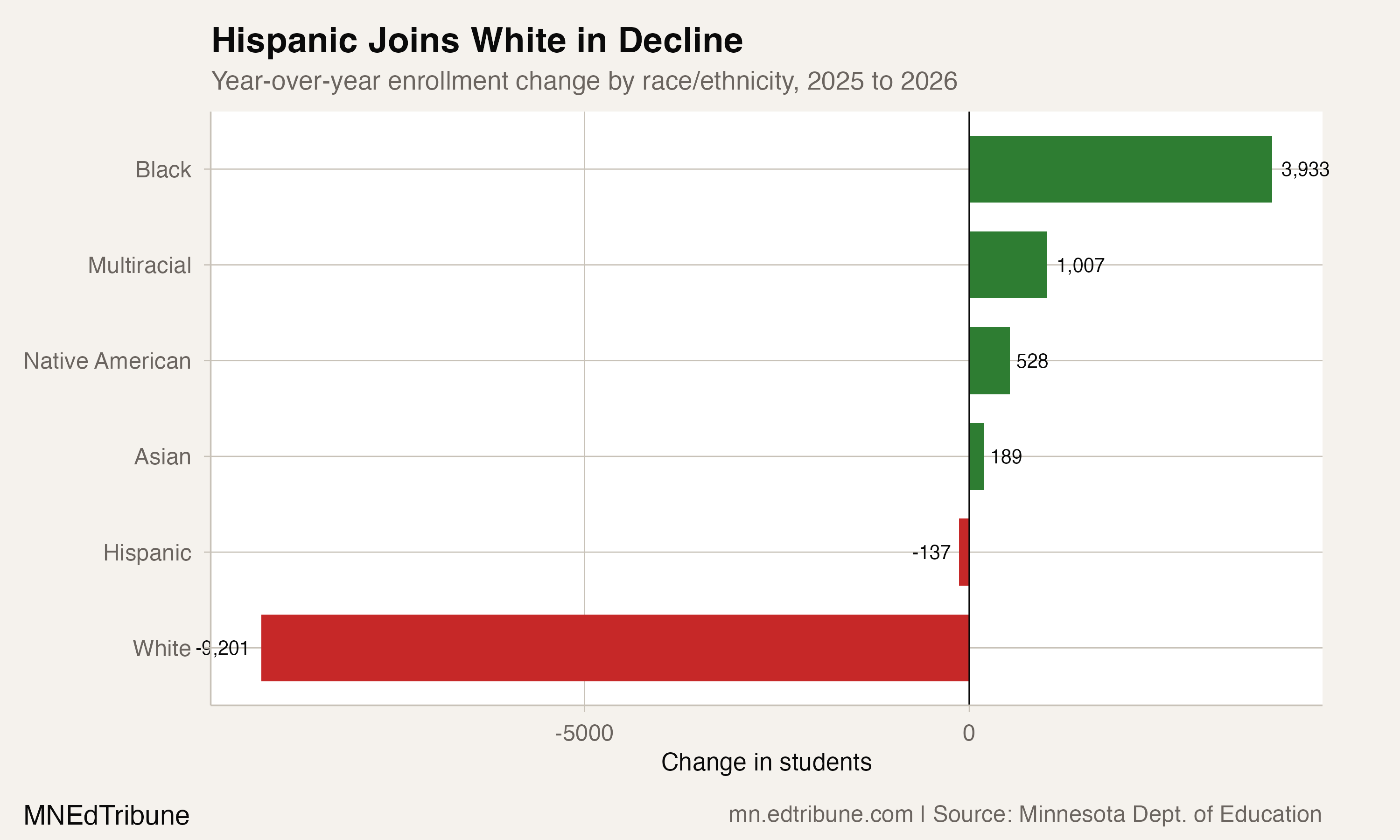
A single year does not make a trend. But it does break one.
Operation Metro Surge and the attendance collapse
The timing of the decline coincides with a period of unprecedented disruption for immigrant communities in Minnesota. Beginning in December 2025, the federal government deployed more than 3,000 immigration agents to the Twin Cities metro area in what officials called "Operation Metro Surge." The operation's effects on school attendance were immediate and severe.
On January 9, 2026, two days after an ICE officer fatally shot 37-year-old Renee Nicole Good during a federal enforcement operation in Minneapolis, 51% of students whose home language is Spanish did not show up to school in St. Paul. Absences in the district spiked to 30% in mid-January, up from typical levels. About 7,000 of St. Paul's roughly 33,260 students signed up for a temporary virtual learning option the district launched on January 22.
"We are watching a generation of St. Paul children, and children across this entire country, lose their childhoods to a fear that no child should know." -- Amy Hewett-Olatunde, ESL teacher, St. Paul Public Schools
The virtual program cost St. Paul approximately $905,000 and ended in mid-March 2026. District officials acknowledged it came at an academic cost. "It did not offer the academic rigor that we want to provide to all students," Kathy Kimani, St. Paul's director of school support, told MPR News. "So with seven weeks, there will be some learning loss and gaps."
The enrollment data predates the worst of Operation Metro Surge. Minnesota's official enrollment counts are taken in early October, months before the December 2025 deployment. The -137 decline reflects conditions as of fall 2025. If the attendance disruptions of January and February 2026 translate into permanent departures, those losses would appear in next year's numbers.
Where the losses concentrated
Minneapolis↗ET lost the most Hispanic students of any district, dropping 262, from 6,874 to 6,612, a 3.8% decline. Saint Paul↗ET lost 225, falling from 4,988 to 4,763, a 4.5% decline. Together the Twin Cities' two largest districts accounted for 487 of the statewide decline, meaning the rest of the state actually gained 350 Hispanic students on net.
Columbia Heights↗ET, a small inner-ring suburb, lost 97 Hispanic students, a 5.2% drop from 1,851 to 1,754. The district's superintendent told state lawmakers that enrollment had dropped by 130 students overall, costing nearly $2 million in lost funding. Seven students were detained by federal agents, six of whom were flown to Texas, with two spending over a month in custody.
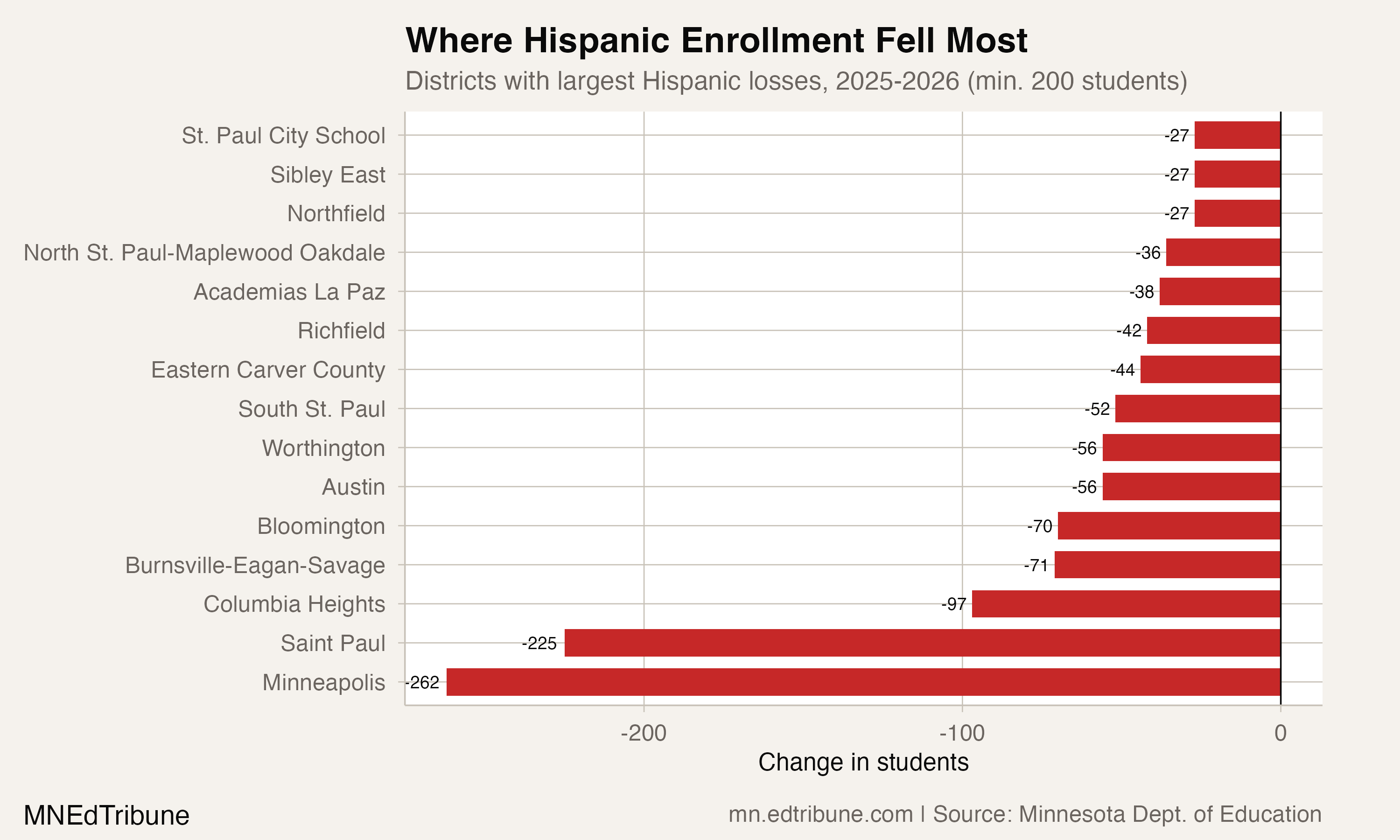
The geographic pattern is striking. Metro-area districts lost a combined 566 Hispanic students, a 1.0% decline. Greater Minnesota districts gained 540, a 1.2% increase. The decline is almost entirely a Twin Cities phenomenon.
Worthington↗ET, a meatpacking town in southwestern Minnesota where a majority of public school students are Hispanic, lost 56 Hispanic students, falling from 2,293 to 2,237. But St. Cloud gained 46, Long Prairie-Grey Eagle gained 46, and Eden Prairie gained 84. The outstate pattern suggests that Hispanic families continue arriving in Greater Minnesota's processing and agricultural centers even as metro enrollment softens.
Competing explanations
Immigration enforcement is the most visible explanation, but it is not the only one. Three forces are plausible.
The enforcement chill is the mechanism with the most direct evidence in Minnesota. Fridley superintendent Brenda Lewis described six ICE vehicles circling a roundabout in front of Hayes Elementary School, preventing children from crossing. Some families are self-deporting. The Minnesota Association of Charter Schools reported that some schools saw attendance drops of 40% or more, with Partnership Academy in Richfield hitting a low of 39% attendance. But the enrollment count was taken in October 2025, before the most intense enforcement. The enforcement hypothesis better explains what may come next than what happened in 2025-26.
A second possibility is demographic maturation. Hispanic fertility rates nationally have declined significantly since the Great Recession, and Minnesota's Hispanic population has followed the same pattern. The state's Hispanic population skews young, but falling birth rates mean smaller entering kindergarten cohorts. If the Hispanic population's age structure is normalizing, growth would slow regardless of immigration policy.
A third factor is the composition of recent arrivals. The large gains in 2024 and 2025, 4,253 and 5,385 respectively, were unusually high. They may have included a surge of unaccompanied minors and families who have since moved on to other states, aged out of K-12, or whose placement was temporary. A partial reversal after two outsized years would be mechanical, not structural.
The most likely answer involves all three. The data cannot distinguish between a student who left because their family was deported, a student who was never born, and a student who aged out.
What the share plateau means
Hispanic students now represent 11.6% of Minnesota's public school enrollment, up from 5.7% in 2007. That share barely budged from 2025 to 2026, ticking up by 0.03 percentage points only because total enrollment fell faster than Hispanic enrollment.
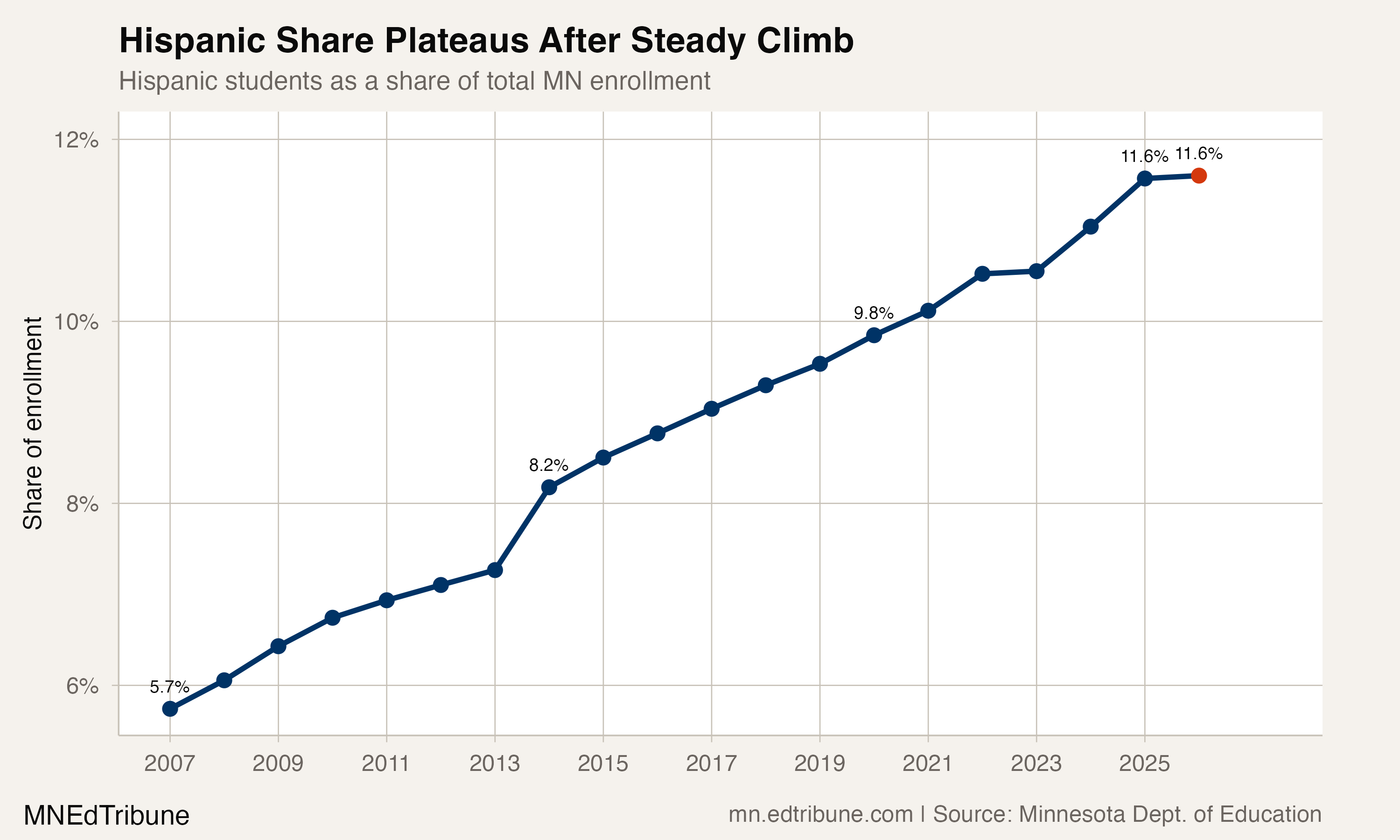
The share plateau matters because Hispanic growth has been the primary demographic counterweight to white decline. White enrollment has fallen by 130,507 students since 2007. Hispanic enrollment grew by 53,034 over the same period, offsetting about 41% of the white loss. If Hispanic growth stalls, the math of Minnesota's enrollment decline changes. The burden of offsetting white attrition shifts entirely to Black students (up 3,933 in 2026) and multiracial students (up 1,007), neither of which are growing fast enough to close the gap.
Under Minnesota's school funding formula, which is calculated in part on average daily attendance, districts serving large Hispanic populations face a compounding problem. Enrollment declines reduce per-pupil aid. Attendance disruptions from immigration enforcement further reduce the daily count on which funding is calculated. Students absent for 15 consecutive days are disenrolled under state law.
The next enrollment count, taken in October 2026, will capture whether the spring's attendance disruptions translated into permanent losses. If they did, the 137-student decline will look like a precursor, not an anomaly.
Detailed code that reproduces the analysis and figures in this article is available exclusively to EdTribune subscribers.
Discussion
Sign in to join the discussion.
Loading comments...