In this series: Minnesota 2025-26 Enrollment.
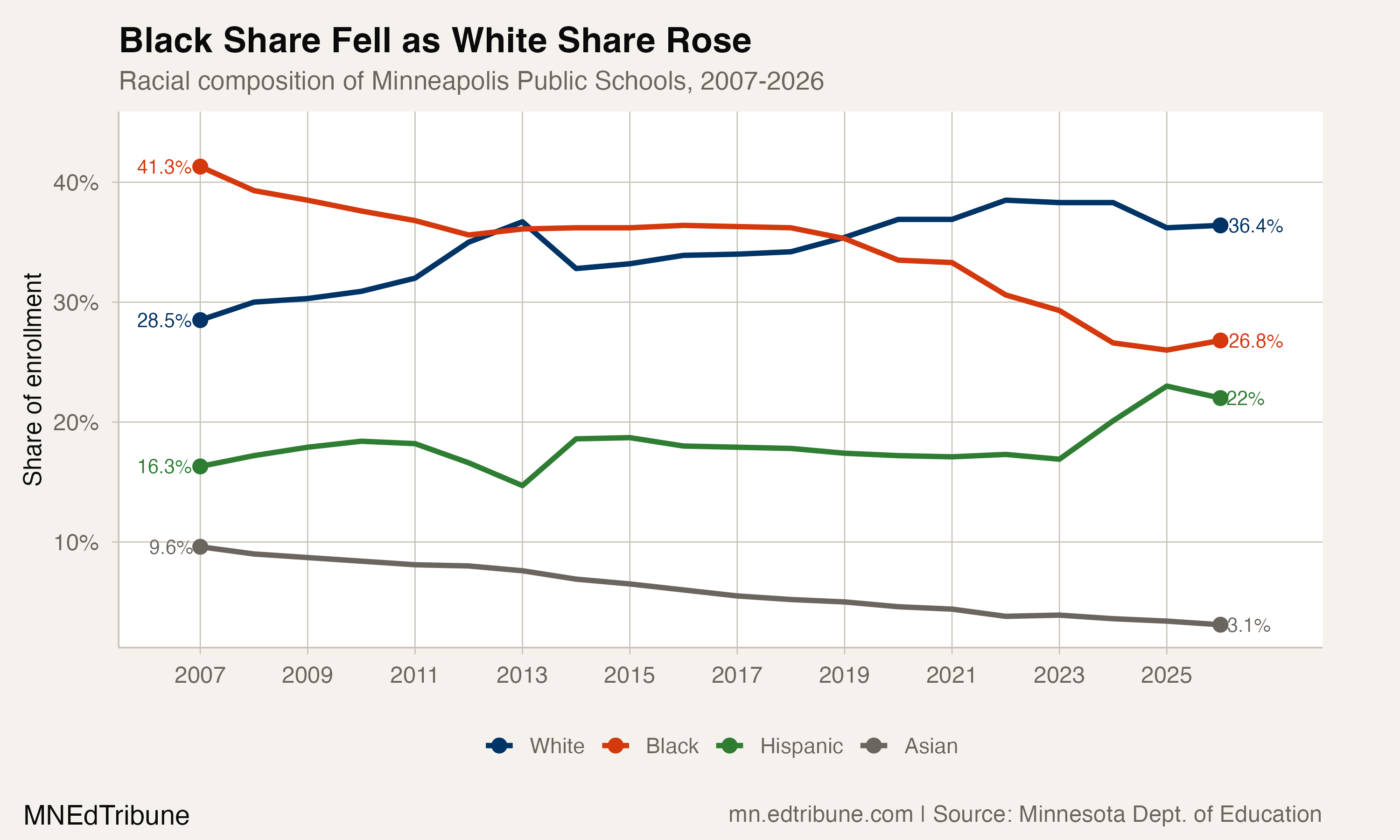
In 2007, Black students were the largest racial group in Minneapolis↗ET Public Schools, accounting for 41.3% of enrollment. White students made up 28.5%. Nineteen years later, those positions have reversed: white students now represent 36.4% of MPS enrollment, Black students 26.8%.
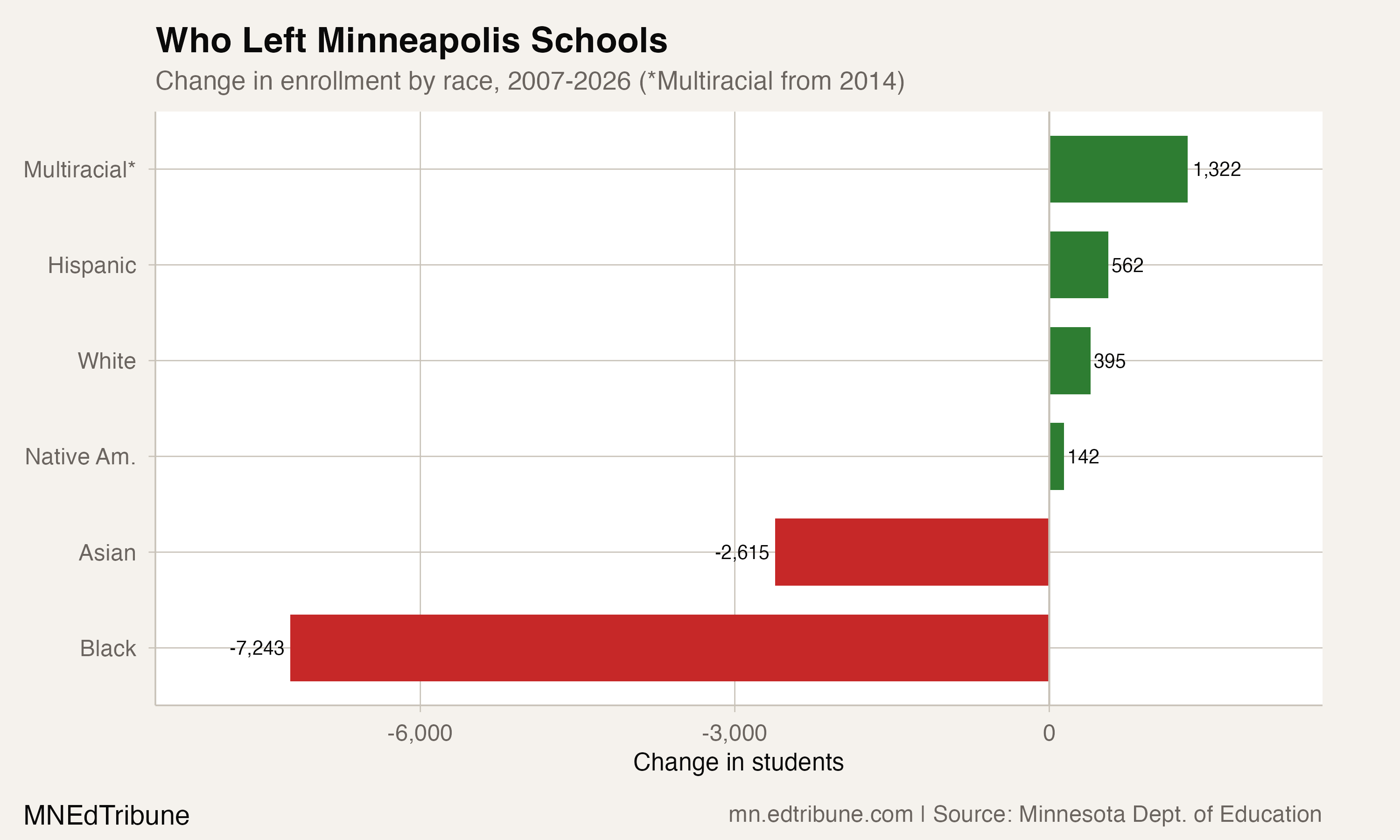
The shift did not happen because white families moved in. White enrollment barely changed, rising from 10,540 to 10,935 over two decades, a gain of 395 students. What changed is that Black families left. MPS lost 7,243 Black students since 2007, a 47.3% decline. Asian enrollment fell even more steeply in percentage terms, dropping 73.6%. The district did not become whiter by addition. It became whiter by subtraction.
A crossover two decades in the making
The racial share lines crossed in 2019-2020, when white students durably overtook Black students as the district's largest group. A brief crossover had occurred in 2013, when white share hit 36.7% and Black share dipped to 36.1%, but Black enrollment rebounded for several years before resuming its decline.
The gap has since widened. By 2022, white share peaked at 38.5% while Black share fell to 30.6%, an 8 percentage-point spread in a district that was 13 points in the opposite direction just 15 years earlier. In 2025-26, the gap sits at 9.6 points: 36.4% white, 26.8% Black.
The arithmetic of the inversion is stark. MPS lost 6,954 total students since 2007, an 18.8% decline. Black students account for more than 100% of that net loss: the 7,243 Black students who left exceed the total decline because small gains among white (+395), Hispanic (+562), multiracial (+1,322 since 2014), and Native American (+142) students partially offset the departures.
The Asian collapse and culturally specific charters
The steepest percentage decline belongs to Asian students, whose enrollment fell from 3,555 to 940, a 73.6% drop. The share collapsed from 9.6% to 3.1%. Much of this reflects the growth of Hmong-serving charter schools that offer language instruction and cultural programming MPS does not.
Hmong College Prep Academy, the largest of these schools, enrolled 2,456 students in 2025-26. New Millennium Academy enrolled 832 and HOPE Community Academy enrolled 737. Together, these three charters alone serve more than four times the number of Asian students remaining in MPS.
Noble Academy, a Hmong charter school in Brooklyn Park, has drawn families seeking cultural preservation alongside academics. Its superintendent, Neal Thao, has said families choose the school because "they want to make sure that the kids know how to read and write" while also maintaining Hmong language and traditions. Teacher Xee Yang described the mission: "I want to help my community preserve the language and culture."
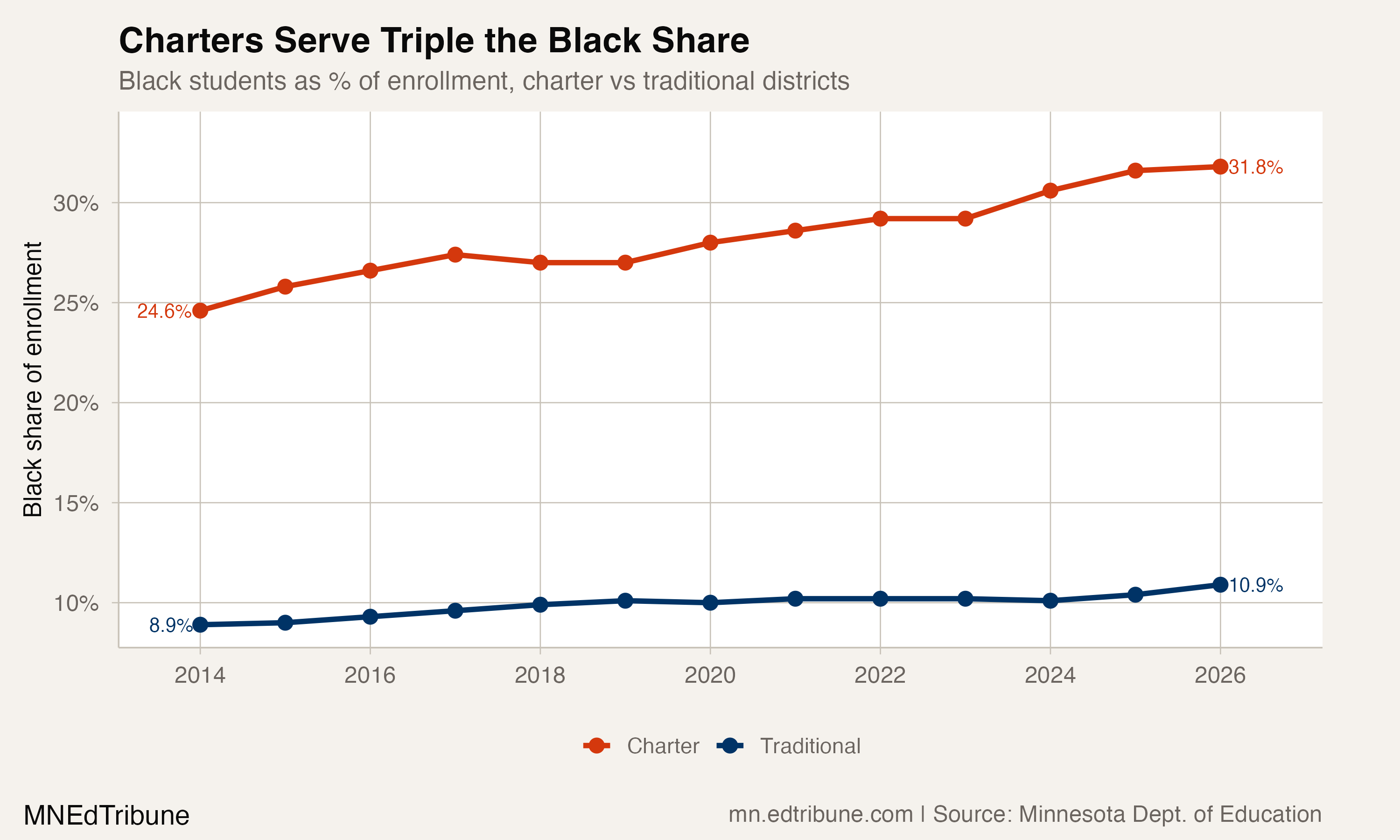
The pattern is not unique to Hmong families. Statewide, charter schools enroll Black students at triple the rate of traditional districts: 31.8% of charter enrollment is Black, compared to 10.9% in traditional districts. One in five Black students statewide, 23,138, now attends a charter school.
What drove families out
The losses accelerated sharply after 2020, when the district lost 4,533 total students and 3,553 Black students in six years. Three forces converged.
The pandemic hit first. MPS kept buildings closed longer than many suburban and charter competitors, and families who left during remote learning did not return. According to MPS Schools Voices, there are 12,000 fewer children living in Minneapolis in 2023 than in 2019. Of 6,000 students who departed MPS since 2019, only about 1,000 remained in Minneapolis enrolled in charter schools or other districts. The rest moved away.
The Comprehensive District Design landed second. In May 2020, the board voted 6-3 to approve a sweeping redistricting plan that redrew boundaries for nearly all 58 MPS schools, converted community schools from K-8 to K-5, and overhauled magnet program locations. The plan aimed to reduce racial and economic segregation by moving magnet schools into historically underinvested neighborhoods. Opposition was fierce. One board member estimated it ran 90% against. The redesign took effect in 2021-22, when exhausted pandemic families were already looking for exits.
The budget crisis followed. FOX 9 reported that MPS faces a $75 million budget shortfall for 2025-26 and plans to cut hundreds of full-time positions. The district operates 73 buildings with capacity for 42,000 students but serves only about 29,000. After April and May transformation materials, the school board directed staff on June 9 to develop three building-use options by September 2026.
The year-over-year picture
The Black enrollment losses have not been steady. They came in waves: a massive 1,534-student drop in 2008, a brief recovery in 2013-2014 when the district gained about 880 Black students over two years, and then a devastating stretch from 2020 through 2025 that saw cumulative losses of more than 3,800.
The single worst year was 2021-22, when MPS lost 1,693 Black students, coinciding with the first year of the CDD implementation. The most recent year, 2025-26, shows a gain of 289 Black students, the first meaningful increase since 2016.
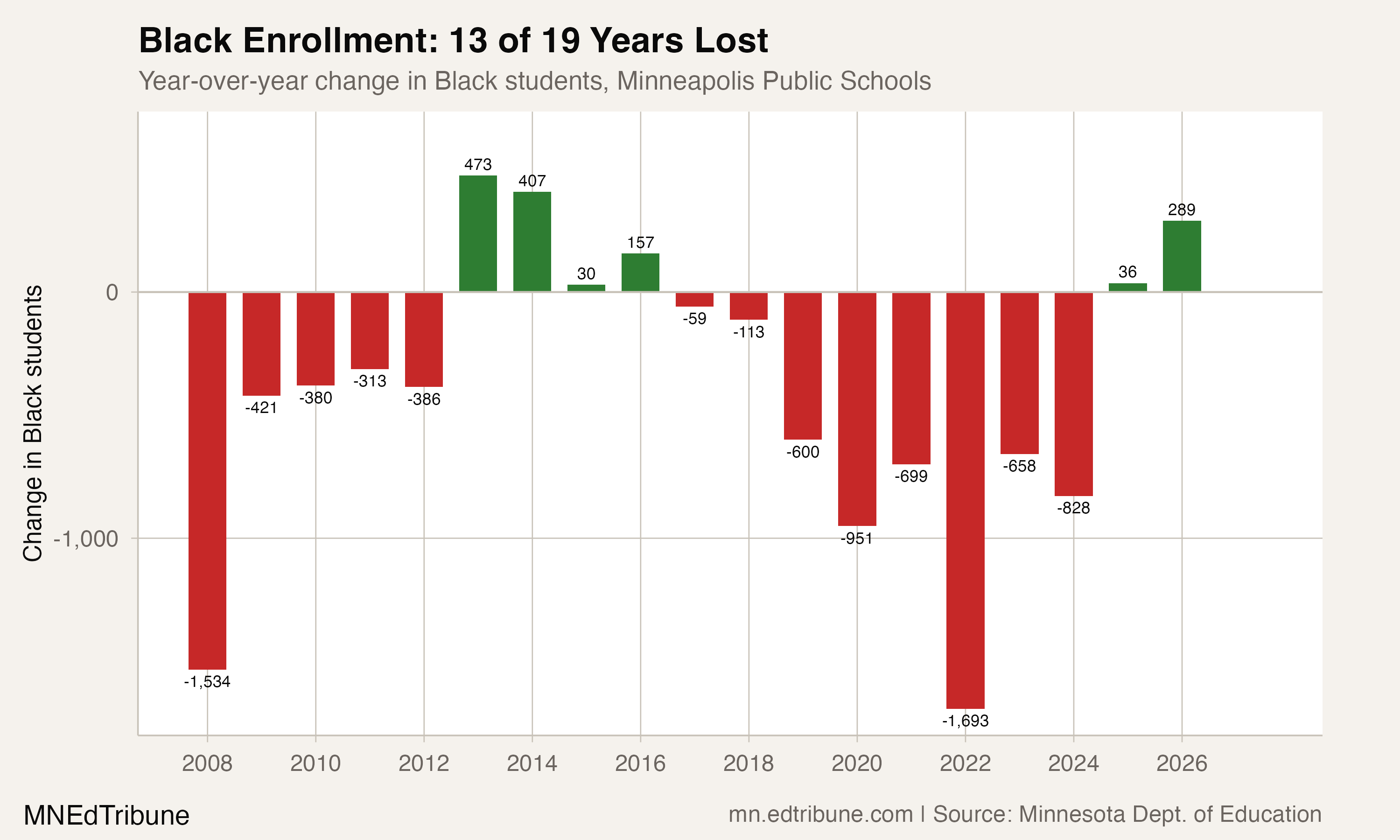
Whether that uptick represents a stabilization or a one-year blip is impossible to determine from a single data point.
Asked what is behind the recent uptick and how MPS plans to sustain it, the district pointed to identity-affirming programs and broader recruitment. "MPS is excited that it remains a district of choice for students and caregivers who identify as Black," Superintendent Lisa Sayles-Adams said in a written statement. "We're proud to offer programming that affirms Black identity, but we've been working hard to attract and retain students of all backgrounds." Sayles-Adams, who began her own career as a teacher in MPS and was named Minnesota Superintendent of the Year in January, framed her return as "a profound homecoming" and emphasized program breadth across "fine arts, global studies and humanities, STEM/STEAM, Montessori, or Spanish dual language."
Limitations of the enrollment lens
This analysis tracks students enrolled in Minneapolis Public Schools. It cannot distinguish between families who moved out of the city, families who stayed in Minneapolis but chose charter or private schools, and families who left the state entirely. MPS estimates that charter schools and open enrollment together account for about 42% of public school students living within district boundaries, up from 37% in 2019. But the enrollment data alone does not reveal motivation.
The racial inversion also reflects a classification question. The multiracial category, which did not exist in MPS data before 2014, grew from 459 to 1,781 students. Some students previously counted as Black may now identify as multiracial, meaning part of the measured Black decline reflects changing self-identification rather than departures.
A district remaking itself by attrition
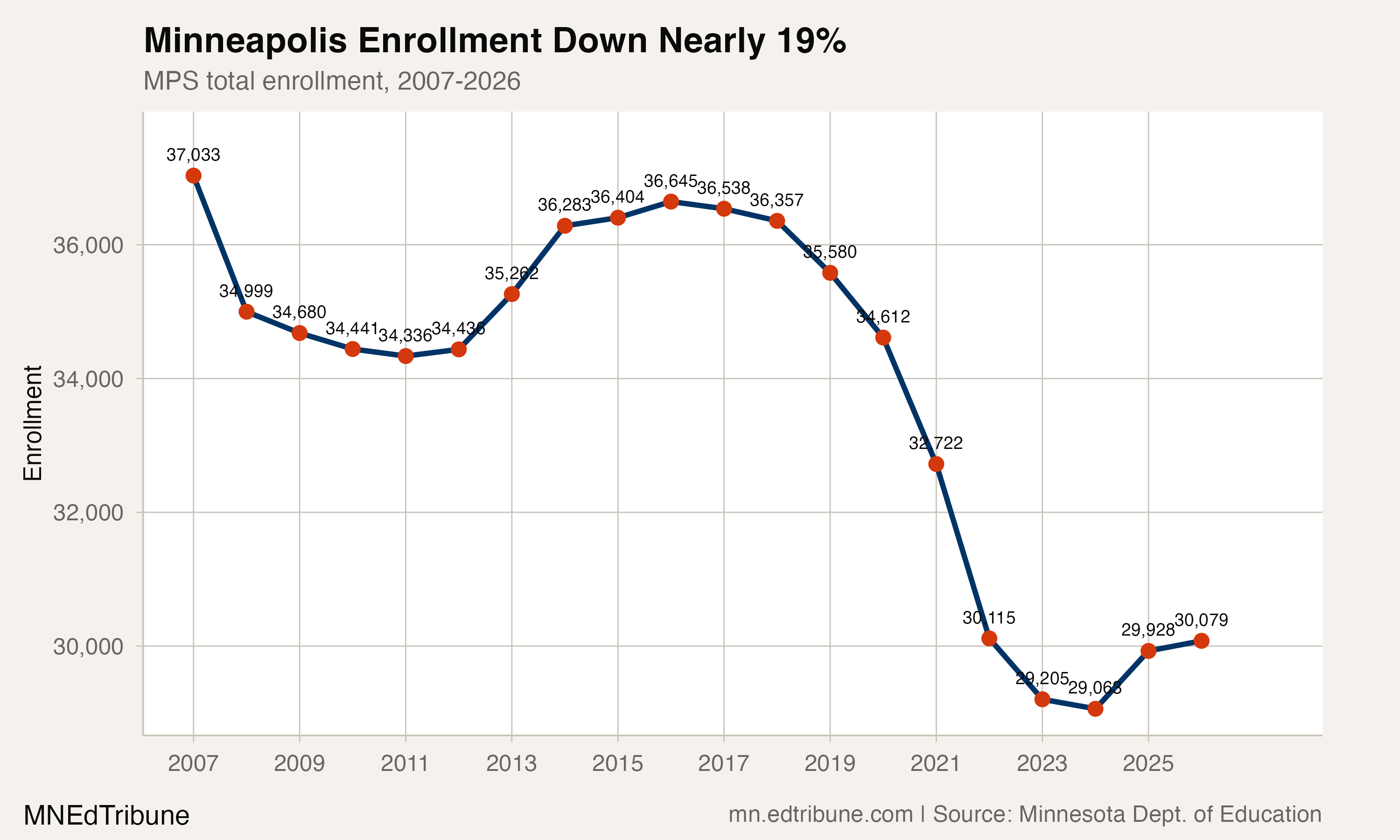
Minneapolis Public Schools now enrolls 30,079 students, down from 37,033 in 2007. The district that was 41% Black is now 27% Black. The district that was 29% white is now 36% white. Hispanic students have grown from 16.3% to 22%, becoming the second-largest group ahead of Black students if current trends continue.
The fiscal consequences are immediate. Per-pupil funding follows the student, and each departure reduces the district's revenue. The $75 million deficit is not an abstract projection. It is hundreds of layoffs, potential school closures, and reduced services in a district where special education spending is increasing by $7.5 million even as overall enrollment contracts.
The district's building-consolidation process now points to September 2026 options. MPS operates 73 buildings with capacity for 42,000 students and serves 30,079. Every closure will force families to choose again: stay with MPS and absorb the disruption, or leave for the charter or suburban district that is already closer to the new commute. The last time the district forced that choice, with the Comprehensive District Design in 2021, it lost 1,693 Black students in a single year. The 289 Black students who returned in 2025-26 would not survive another round of that arithmetic.
Detailed code that reproduces the analysis and figures in this article is available exclusively to EdTribune subscribers.
Discussion
Sign in to join the discussion.
Loading comments...