In this series: State Recovery | Racial Equity Chasm | Rochester's Stubborn Rate | Pequot Lakes Turnaround | Poverty-Absence Nexus | Minneapolis Volatile Trajectory | Districts at All-Time High | Consistent Attendance Leaders | Moorhead Escalating
Correction: An earlier version understated Minnesota's statewide rate and overstated the district-state gap. This version also restores the omitted 2020-21 Red Lake figures. The Minnesota Department of Education records show a declining Red Lake rate across the full available series; the district ranking remains bounded to entities with at least 500 students.
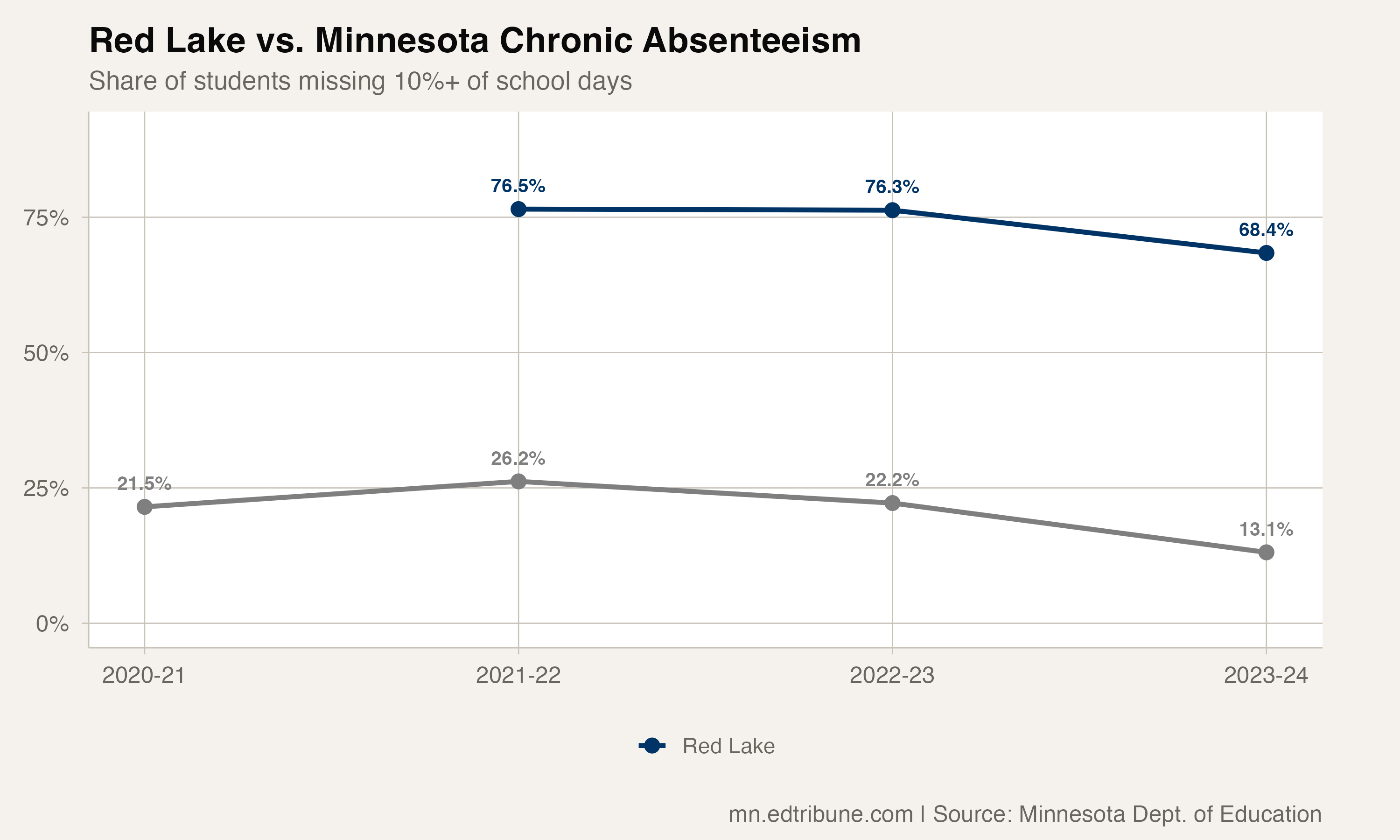
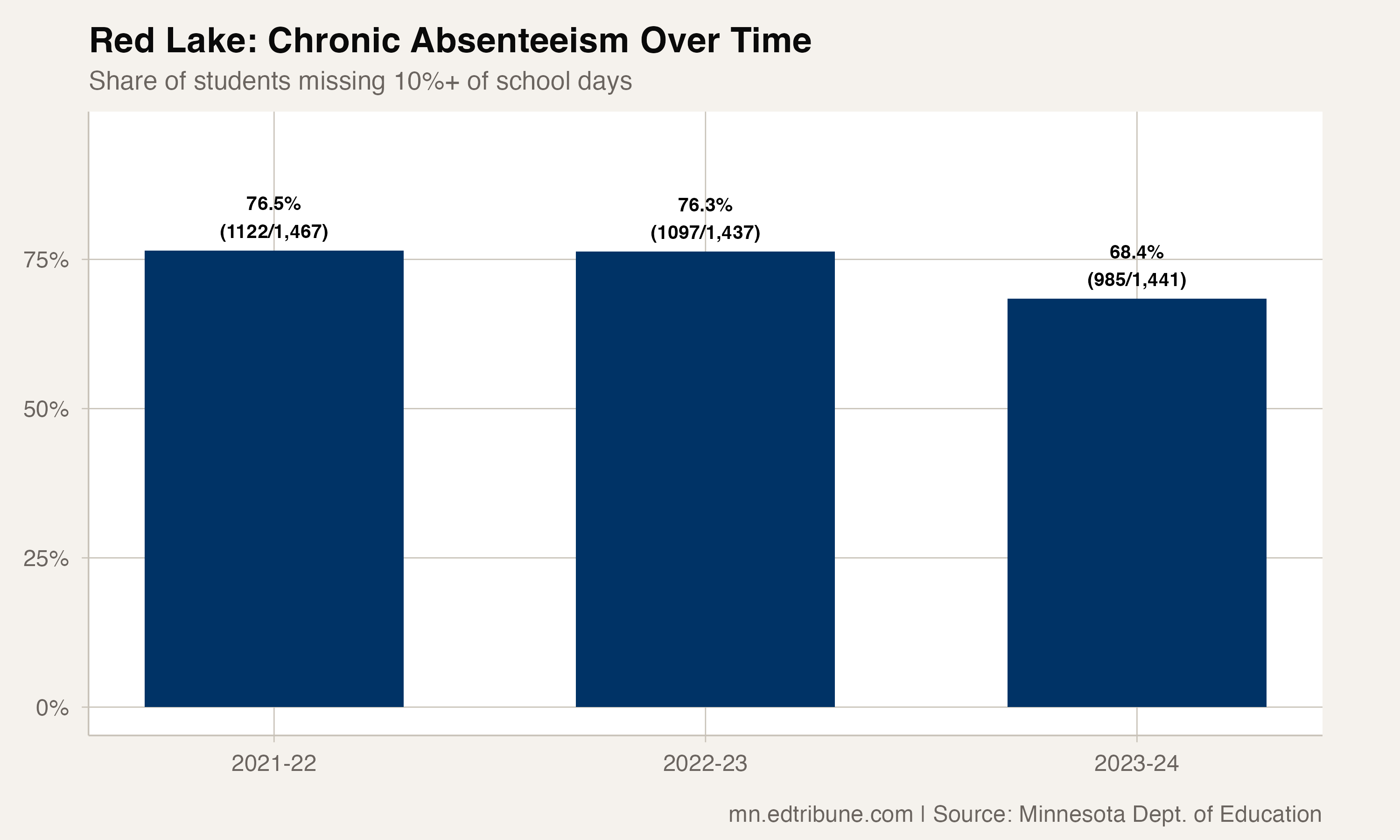
In 2023-24, 985 of the 1,441 students in Red Lake Public School District↗ET were counted as chronically absent. That produced a 68.4% rate, about two-thirds of district enrollment.
The rate was 76.5% in 2021-22 and 76.3% in 2022-23. The decline to 68.4% was an 8.1-percentage-point improvement from 2021-22. The earlier 2020-21 report recorded 1,366 students counted as chronically absent among 1,526 enrolled, a rate of 89.5%. Across the full available series, Red Lake's rate fell by 21.1 points.
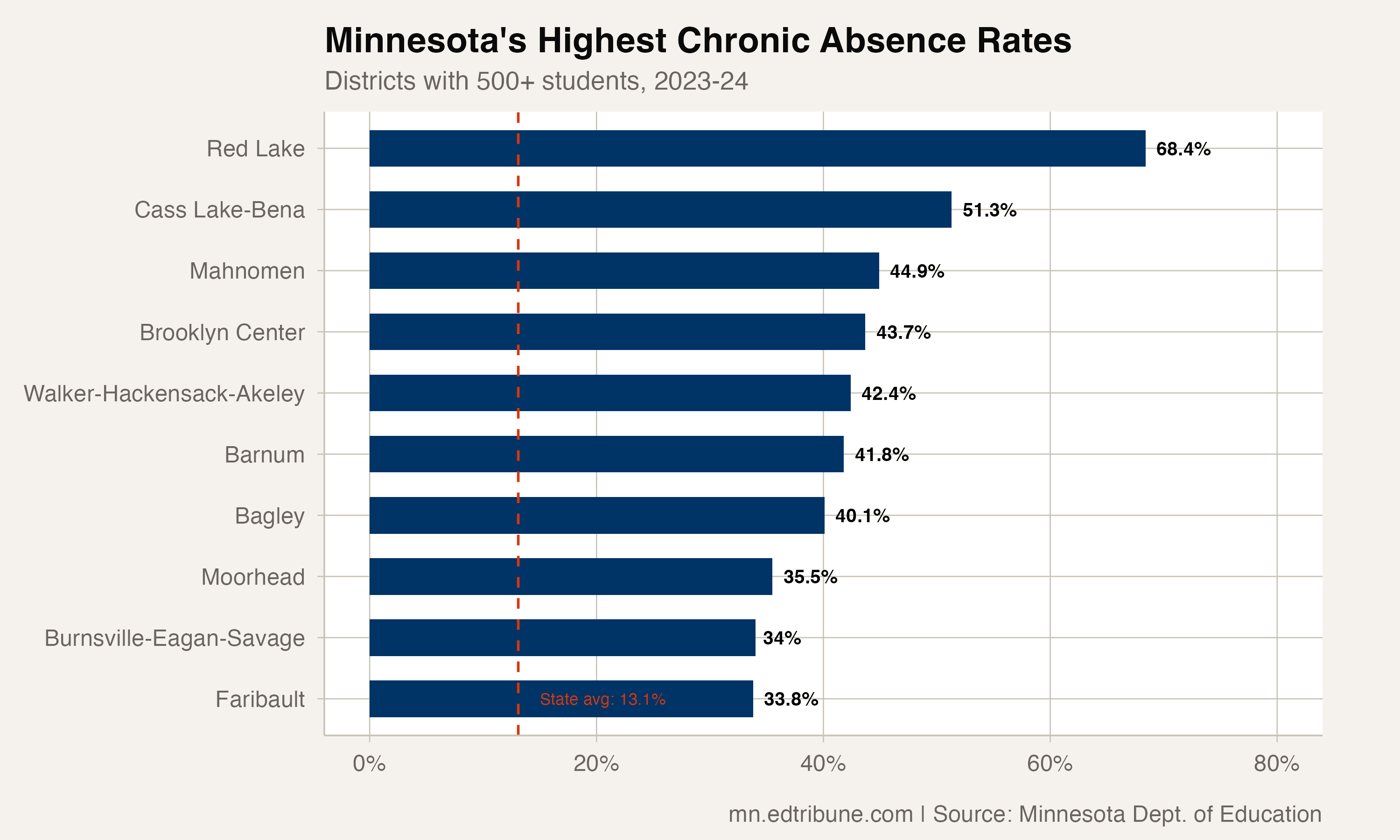
The latest Red Lake rate was 3.2 times Minnesota's 21.4% statewide rate, a 47.0-point difference. Among all district-level entities, including charter districts, with published valid totals and at least 500 students in the state's 2023-24 files, Red Lake had the highest chronic-absence rate. That comparison included 291 entities with 93.5% of Minnesota's published enrollment.
A crisis measured in children
Red Lake's reported enrollment changed by 26 students from 2021-22 to 2023-24, a 1.8% decline. Over the same period, the number counted as chronically absent fell by 137, from 1,122 to 985.
| Year | Chronic Rate | Students Absent | Enrollment |
|---|---|---|---|
| 2020-21 | 89.5% | 1,366 | 1,526 |
| 2021-22 | 76.5% | 1,122 | 1,467 |
| 2022-23 | 76.3% | 1,097 | 1,437 |
| 2023-24 | 68.4% | 985 | 1,441 |
Other high-rate districts
Red Lake was not the only district far above the state rate. Cass Lake-Bena Public Schools↗ET reported 571 chronically absent students among 1,112 enrolled in 2023-24, a 51.3% rate. Its available series was 54.2% in 2021-22, 49.2% in 2022-23 and 51.3% in 2023-24.
Mahnomen Public School District↗ET reported 292 chronically absent students among 650 enrolled, a 44.9% rate. The state's attendance files report district totals; it does not establish the demographic composition or causes behind any district's rate.
What the gap means for the state
Minnesota's statewide rate fell from 26.2% in 2021-22 to 22.2% in 2022-23 and 21.4% in 2023-24. Red Lake's rate fell by more over the full interval, so the district-state gap narrowed from 50.3 to 47.0 points. It was 54.1 points in the intervening year.
The numbers establish a severe attendance difference and a recent improvement. They do not identify why students were absent or which actions, if any, produced the decline. Red Lake's latest rate remained the highest among Minnesota districts with at least 500 students even after the 21.1-point decline across the full available series.
Detailed code that reproduces the analysis and figures in this article is available exclusively to EdTribune subscribers.
Discussion
Sign in to join the discussion.
Loading comments...