Carl Schlueter became executive director of Spero Academy↗ET on July 1, taking over a school that has nearly quadrupled in twelve years and that now runs out of two buildings instead of one.
The Minneapolis charter school enrolled 297 students in 2025-26. In 2014-15, when it was still called Fraser Academy, it enrolled 80. That is 217 more students, an increase of about 271 percent, over twelve years in which Minnesota's total public school enrollment moved 1.9 percent.
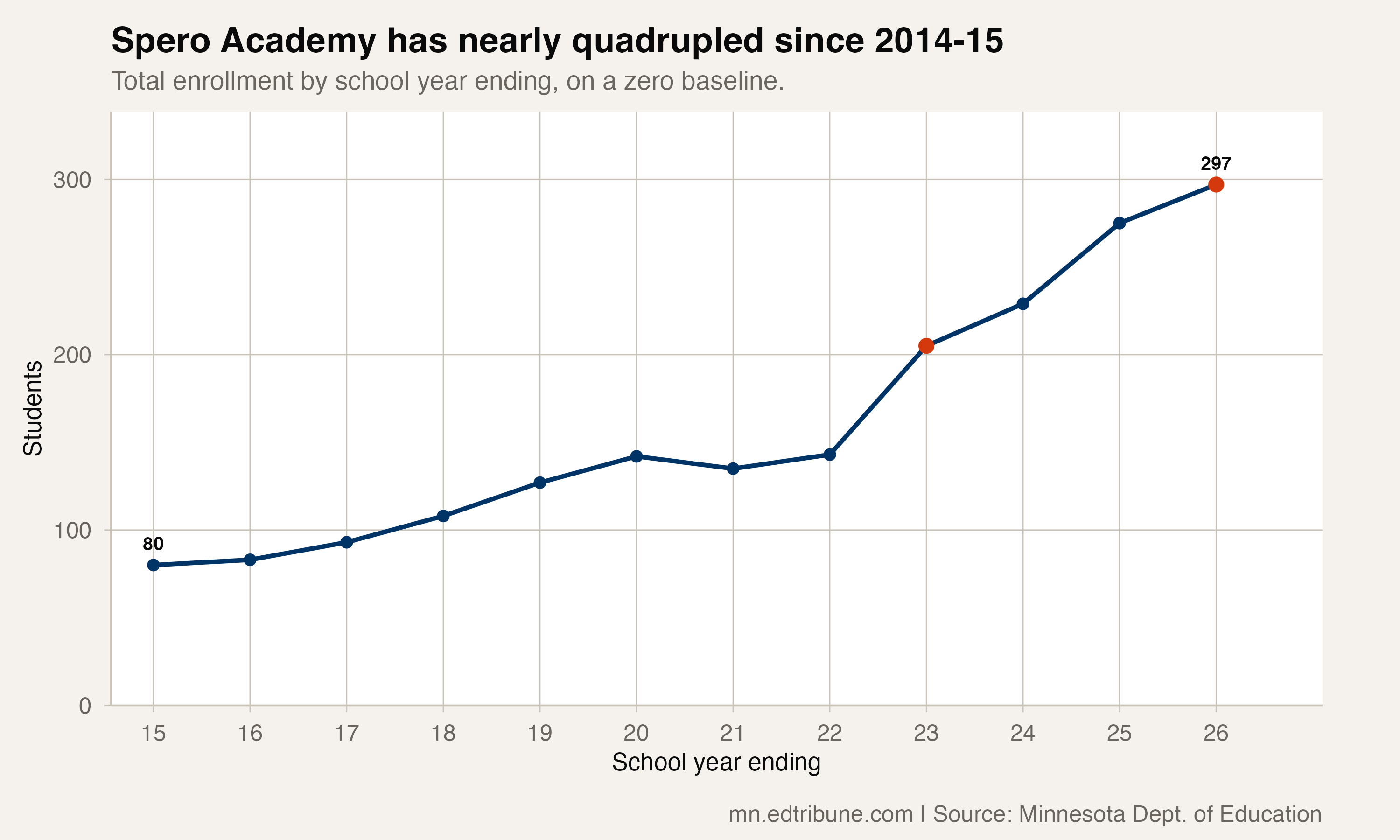
The growth has been almost uninterrupted. In eleven year-over-year transitions the school has fallen exactly once, by 7 students in 2020-21.
Where the students actually came from
The headline percentage is easy to overstate on a base this small, so it is worth being precise about where the students are.
Spero opened a second campus in Brooklyn Park in 2022-23. It started with 52 students. In 2025-26, the most recent year Minnesota has published, it enrolled 148.
The original campus, over that same stretch, went from 143 students to 149.
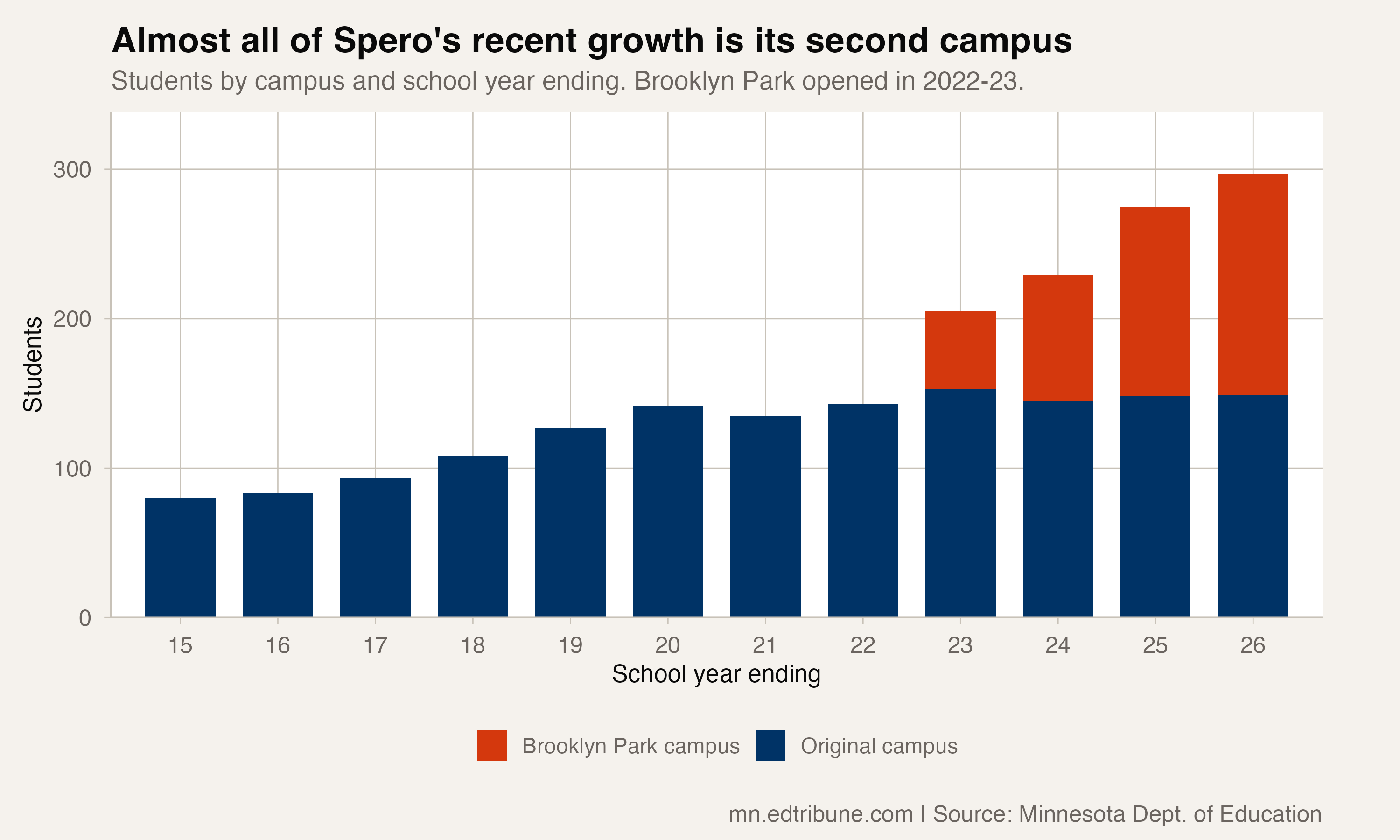
Spero has added 154 students since 2021-22. Six of them are at the campus it started with. By 2025-26 the two buildings were within one student of the same size.
The enrollment file records where students are enrolled, not why. It cannot say whether the original building is full, whether families in Brooklyn Park were waiting for a nearer option, or whether the school made a deliberate choice to grow sideways rather than up. What it does establish is that Spero's recent growth is not the original school getting bigger. It is a second school.
Schlueter said he was not part of Spero's own decision to open the Brooklyn Park building, but he described what a second campus generally requires of a Minnesota charter school: review and comment by the state education department, which he said typically involves a market study; support from the school's authorizer, the University of St. Thomas, on the school's capacity to run it; and an extensive site search. He said the options for a school expanding an existing footprint are often limited and vertical construction difficult, which can make a second campus the most feasible route.
That happens to be the part of the job Schlueter says he has done before.
"I have previous experience working in a two-campus model," he wrote in response to questions from The MNEdTribune. "The benefits of this are that a second campus provides additional enrollment opportunities for families to choose the best school for their children. Other opportunities involve sharing strategies, solutions, and best practices between two buildings including colleagues in correspnding positions with whom to engage, consult, and cooperate . A challenge is to maintain unity and consistency in programs and procedures while recognizing and celebrating what is distinct in the character of each campus."
What he says drew him
Schlueter pointed to the school's instructional model, including a calendar that does not look like most of Minnesota's.
Spero's mission "to provide holistic, adaptive, individualized education in an inclusive and collaborative environment" drew him to the position, he wrote. "In addition, I believe Spero's year-round learning model (school is in session for 11 months, Monday - Thursday) is an innovative response to supporting student learning and growth as well as sustaining and retaining teachers and staff."
His stated priorities for the year are consolidating rather than launching.
"My priorities this year are to build upon a solid and successful foundation by working collectively with others to move the mission forward according to the objectives of the strategic plan," he wrote. "Early on, this means developing strong, trust-based relationships in the school community, familiarizing myself with established systems and practices, and cultivating a positive and encouraging organizational culture."
Asked how he leads, he described a distributed approach.
"My leadership style is facilitative and rooted in relationships that are grounded in values of compassion and commitment, equity and integrity," he wrote. "I believe in shared leadership and the benefit of diverse perpectives. Ensuring decisions are mission-alligned, student-centered, and data-driven is essential to realizing agreed-upon goals and a shared vision."
He also put family partnership and belonging inside that definition of leadership.
"Partnering with families in the progress and development of their children's acadmic, social, and emotional learning so each can reacher their full potential is the key to success," he wrote. "Finally, I believe in fostering a school community and culture of contributing and belonging that is inclusive, welcoming, solution-focused, strength-based."
That focus returns the story from raw enrollment to the coordination challenge his two-campus answer identified. Spero's grade counts measure where children are enrolled. They cannot measure whether programs, procedures or culture feel consistent across the two addresses. That is the work Schlueter has set for himself, and the data provides a clear scale for it.
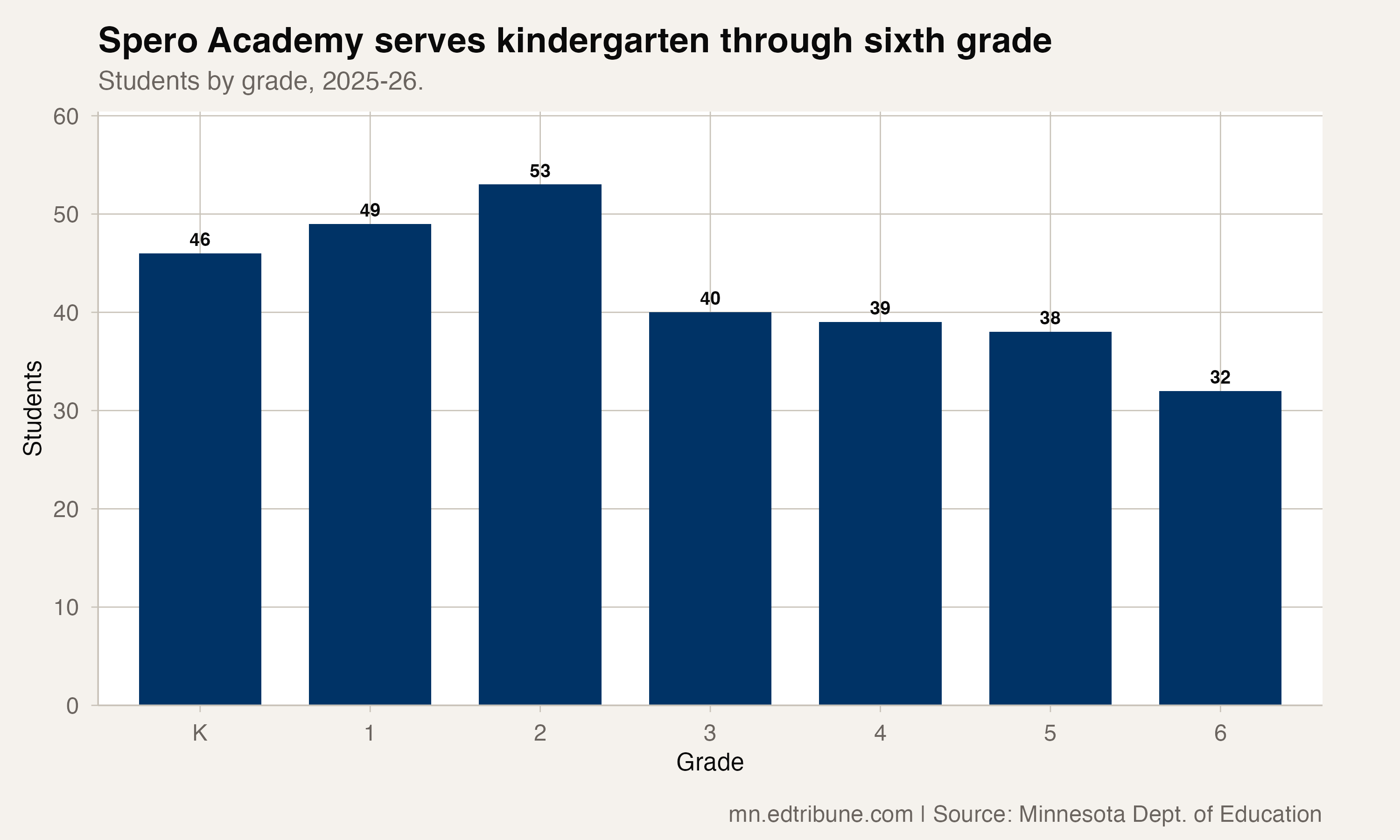
Spero serves kindergarten through sixth grade. In 2025-26 its largest grade was second, with 53 students, and its smallest was sixth, with 32.
A school that has doubled its footprint in three years and splits its students evenly between two addresses is a different organization from the one that enrolled 80 children in a single building. Schlueter's first year will test how a two-campus model keeps operating as a single school under shared leadership.
Enrollment figures come from the Minnesota Department of Education public enrollment record, covering 2014-15 through 2025-26. The school appears in the 2014-15 record under its former name, Fraser Academy. Schlueter responded in writing; his quoted answers appear exactly as he wrote them, including minor keyboard typos.
Detailed code that reproduces the analysis and figures in this article is available exclusively to EdTribune subscribers.
Discussion
Sign in to join the discussion.
Loading comments...