Darren Kern began serving as interim superintendent of Le Sueur-Henderson School District↗ET on July 1 with an advantage that does not show up on an organizational chart: he already knew the people and the place.
Kern has spent more than 30 years in education, he wrote in response to questions from The MNEdTribune. His teaching and administrative roles have included principal, director of special education and superintendent. Most recently, he was Le Sueur-Henderson's elementary principal.
"I believe that combination of district-level leadership experience and already knowing our students, staff, families and communities prepared me well to step into this role," Kern wrote.
The district he now leads enrolled 908 students in 2025-26, the most recent published year and the same count it reported in 2024-25. That stability follows a longer decline: Le Sueur-Henderson enrolled 1,058 students in 2014-15, 150 more than its most recent published total.
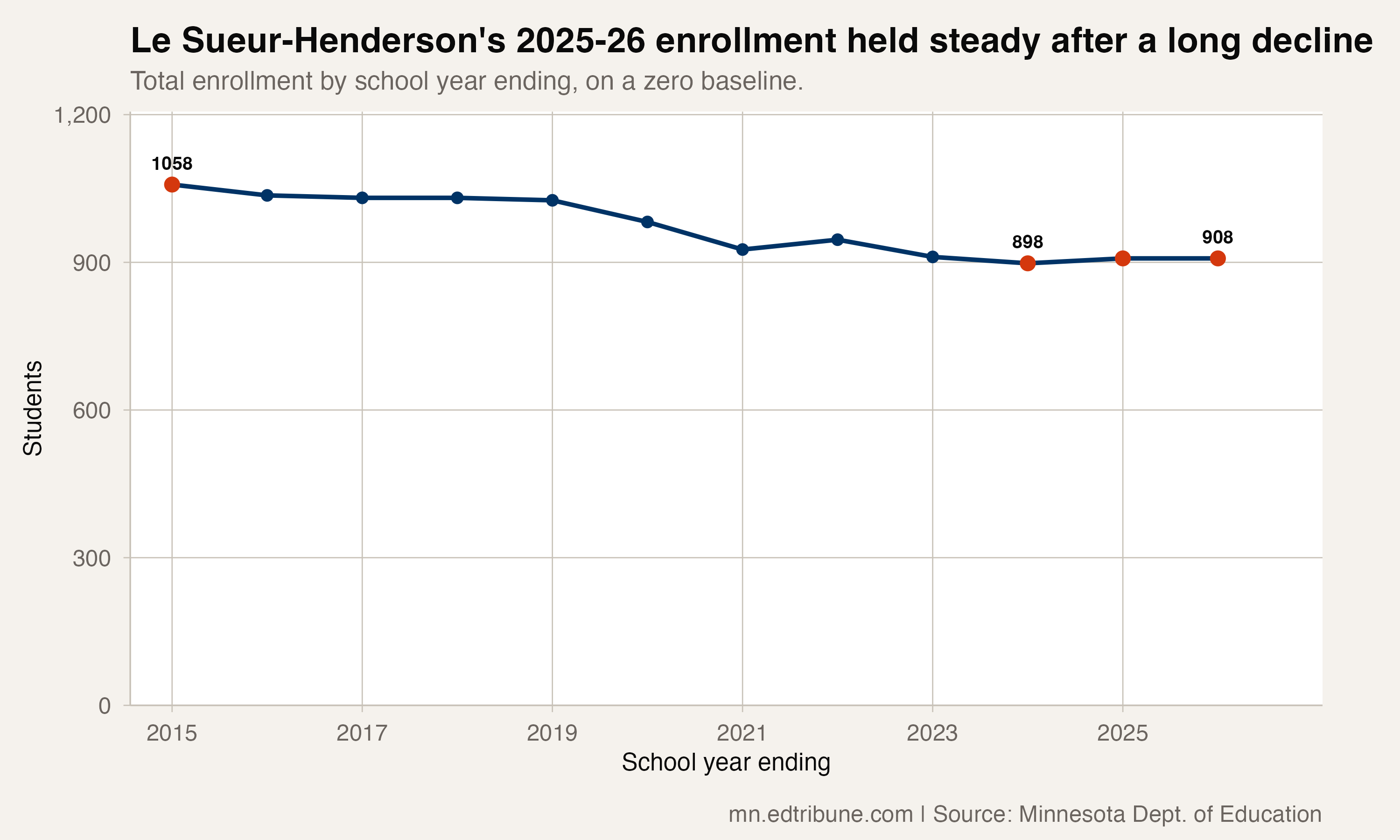
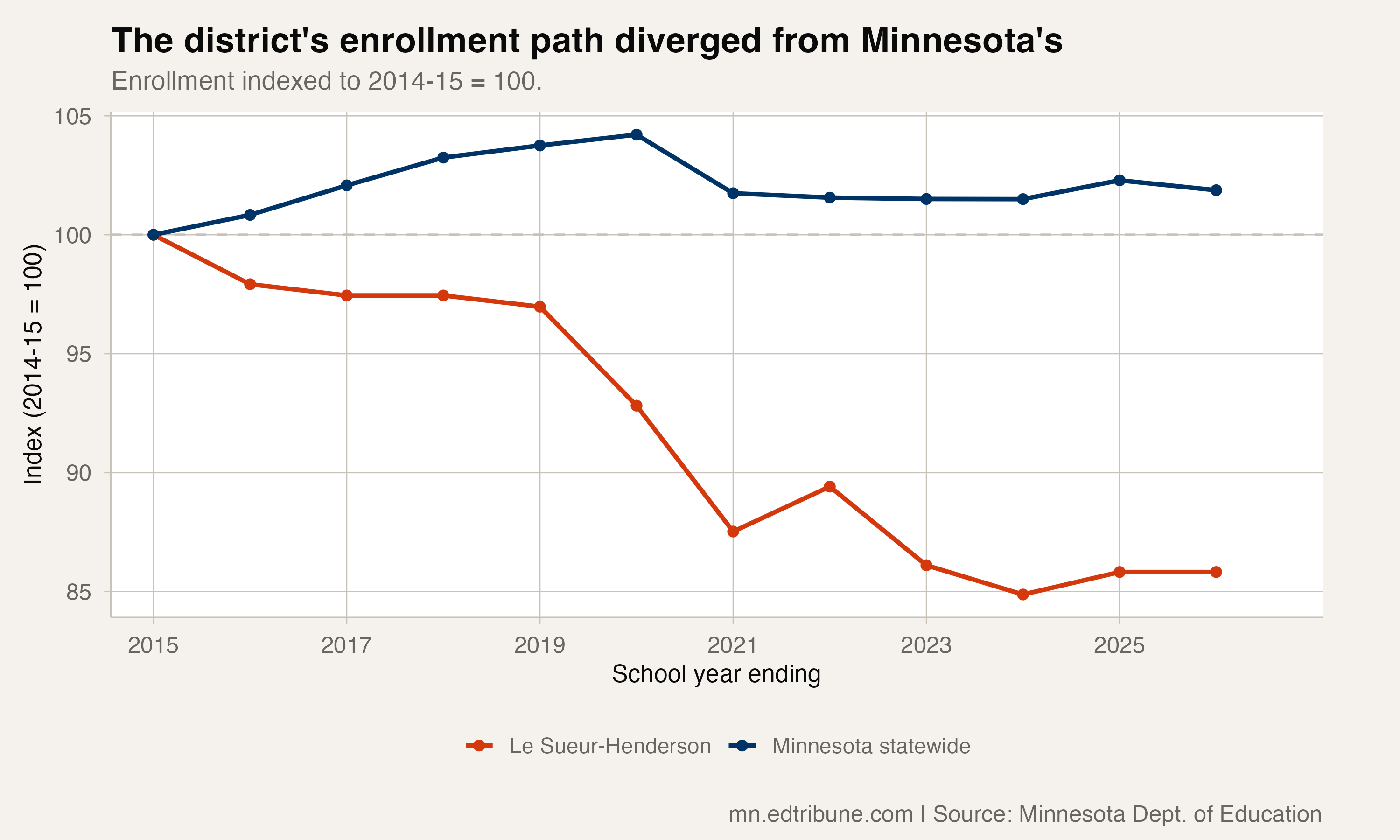
The change across those endpoints is a decline of 14.2%. Minnesota's published enrollment total increased 1.9% over the same years, leaving the district's path 16.1 percentage points below the statewide movement.
That comparison describes the operating landscape Kern inherits. It does not explain why enrollment changed, and every count in the chart predates his July 1 start.
Stability is not the same as recovery
Le Sueur-Henderson's most recent published flat year matters because the district's recent path has moved in both directions. Enrollment rose from 898 students in 2023-24 to 908 the following year, then held at 908 in 2025-26. That count nevertheless remains 38 students, or 4.0%, below 2021-22.
The difference between a flat year and a reversal is important for a leader who named financial and operational soundness among his priorities. The state record can quantify the number of students the district reported. It cannot establish how those counts translate into staffing, programs or budgets, and it cannot credit any decision with the 2025-26 result.
Kern's stated agenda begins with student achievement and the conditions around it.
"My priorities are student achievement, maintaining a strong and supportive environment for students and staff, and ensuring the district remains financially and operationally sound," he wrote. He also said he wants the district to strengthen relationships with families and its communities.
His interim role includes examining the district's systems, he wrote, identifying areas for improvement and positioning Le Sueur-Henderson for long-term success. The enrollment data makes the scale of that systems work visible without prescribing the answer.
A grade spine, not a forecast
Le Sueur-Henderson's 2025-26 grade distribution adds another planning signal. The district reported 55 kindergartners and 71 12th-graders that year, a gap of 16 students. Its three published campus totals reconcile to the district's 908 students.
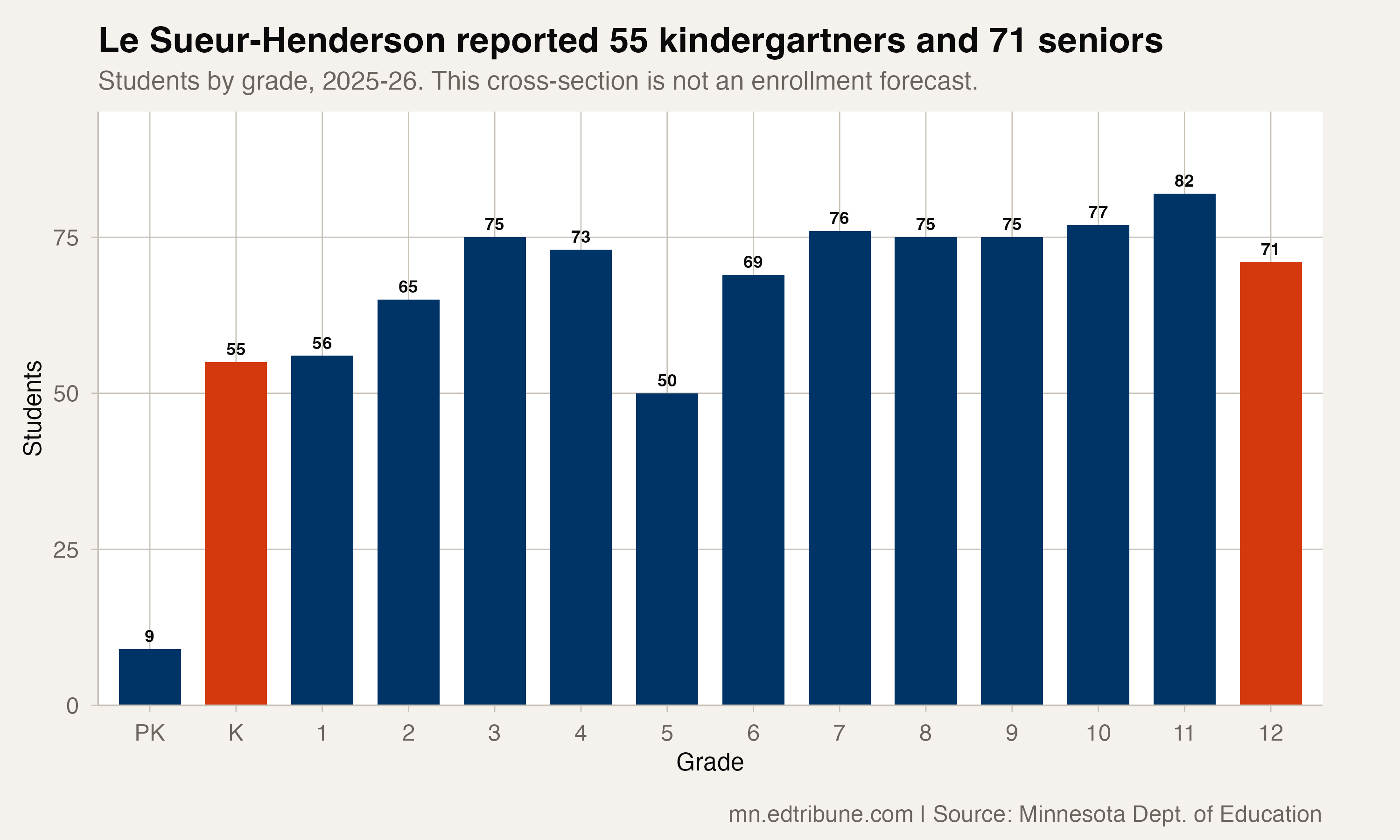
The grade comparison is not an enrollment projection. Students can enter, leave or move between districts before a class reaches graduation, and a single cross-section cannot show what future cohorts will do. It shows the 2025-26 distribution behind the staffing, programming and financial questions Kern has said he will review.
His description of how he plans to make those choices emphasizes access and explanation.
"I want people to know that I will be visible, accessible and willing to listen," Kern wrote. He said good leadership begins with relationships but also requires honesty, accountability and a willingness to make difficult decisions.
People should expect open communication and an explanation of the reasoning behind decisions even when they disagree, he wrote, with students and the district at the center of the work.
That is a testable promise for an interim year. The enrollment record sets the scale: a district that reported 908 students last school year, smaller than it was twelve years earlier, stable in the most recent published count and uneven across grades. Kern's own standard sets the measure for the decisions that follow: visible leadership, clear reasoning and attention to the long-term condition of the district.
Enrollment figures come from the Minnesota Department of Education public record, covering 2014-15 through 2025-26. Kern responded in writing; quotations and biographical details are drawn from that exchange.
Detailed code that reproduces the analysis and figures in this article is available exclusively to EdTribune subscribers.
Discussion
Sign in to join the discussion.
Loading comments...