Greg Cole became superintendent of Anoka-Hennepin↗ET on July 1, moving up from chief operating officer to run the largest school district in Minnesota.
It enrolled 38,336 students in 2025-26, about 4.4 percent of every public school student in the state, or roughly one in 23. The second-largest district, Saint Paul, enrolls 32,750.
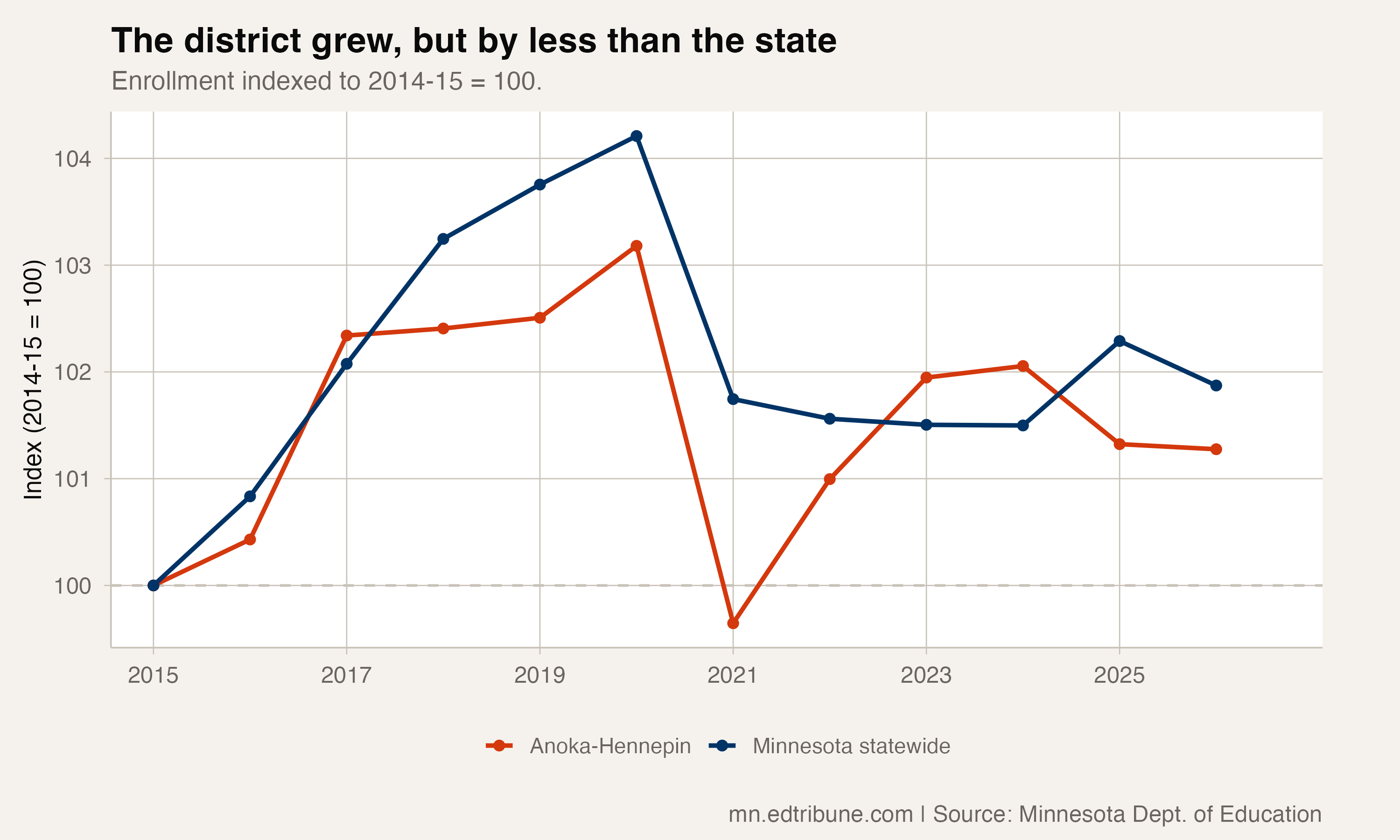
The job he takes over has been remarkably static. Anoka-Hennepin enrolled 37,853 students in 2014-15 and 38,336 in the 2025-26 record, a gain of 483 across twelve years. Minnesota as a whole grew 1.9 percent over the same period; the district grew 1.3 percent, so it added students more slowly than the state did.
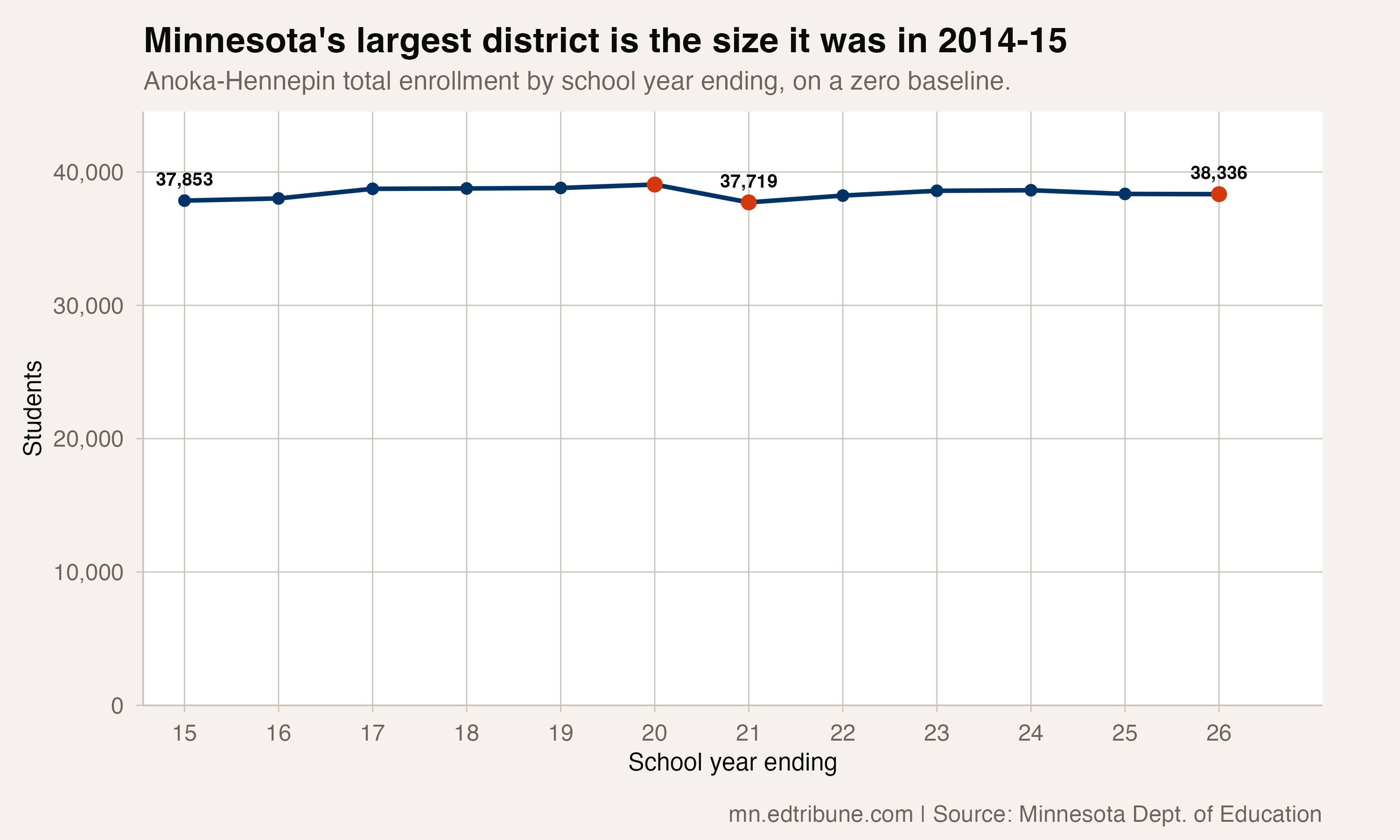
There is a tidy way to see how little the total has moved. Across all twelve published years the district's highest and lowest counts are 1,338 students apart. That is exactly the size of a single year's drop, from 39,057 in 2019-20 to 37,719 in 2020-21. One unusual year accounts for the entire range of the last dozen.
Those years coincide with the pandemic. The enrollment record establishes the timing and nothing else; it cannot separate closures from families moving, from choices about where to enroll a child, or from anything else happening at the same time.
The district recovered most of it. From the 2020-21 low it added 912 students by 2023-24. It has since given back 295 across two consecutive years, which is a slight decline on a base above 38,000 rather than a reversal.
The number underneath the flat line
A district total that barely moves can sit on top of grades that are not balanced at all, and here they are not.
Anoka-Hennepin enrolled 2,263 kindergartners in 2025-26 and 3,501 seniors. The class arriving is 1,238 students smaller than the class leaving, about 35 percent below it.
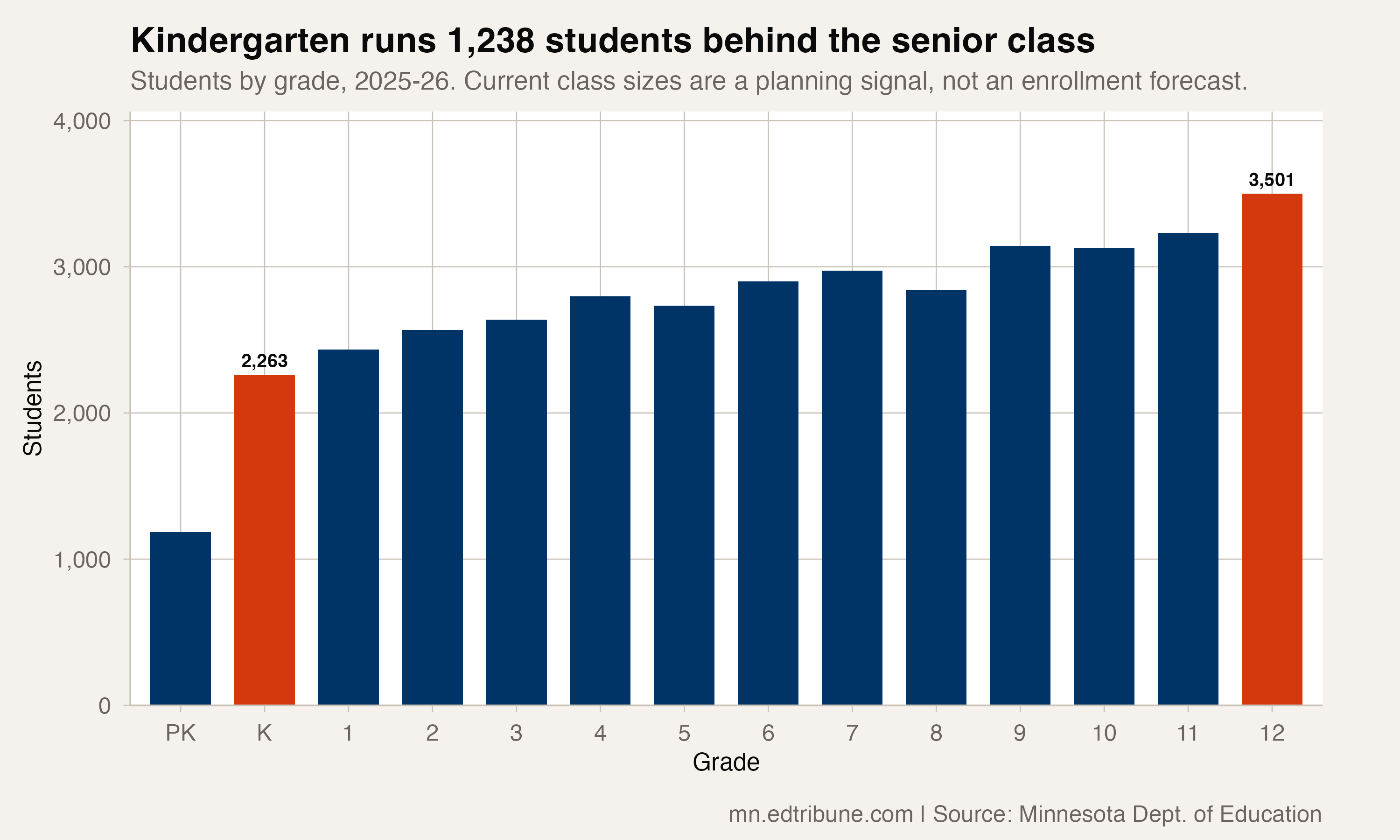
This is a cross-section of the grades in the 2025-26 record, not a forecast. Kindergarten cohorts move with birth counts, housing turnover and family choices that the enrollment file does not record, and a small entering class can be followed by a larger one.
But the arithmetic of a district this size makes the gap concrete. Anoka-Hennepin runs 53 schools. A senior class that is 1,238 students larger than the kindergarten class is the kind of difference that eventually shows up in staffing, building use and budget planning, and it is visible in the 2025-26 enrollment record rather than in some later projection.
What the public record shows about the new superintendent
Cole was promoted internally, effective July 1, 2026, having previously served as the district's chief operating officer. That is an operations background arriving at a district whose central near-term questions are operational: what to do with buildings and staffing if the grades below stay smaller than the grades above.
Whether he reads the grade spine that way is not something the public record establishes, and he did not discuss it with us.
The MNEdTribune contacted representatives of Anoka-Hennepin for comment and did not receive a response before publication.
Enrollment figures come from the Minnesota Department of Education public enrollment record, covering 2014-15 through 2025-26. Figures are keyed on the district's state identifier rather than its name, because Minnesota reuses district numbers across district types.
Detailed code that reproduces the analysis and figures in this article is available exclusively to EdTribune subscribers.
Discussion
Sign in to join the discussion.
Loading comments...