Correction: An earlier version used an incomplete district join and misstated the statewide change. The analysis and examples below have been corrected against the full available panel.
In this series: State Recovery | Racial Equity Chasm | Red Lake Crisis | Rochester's Stubborn Rate | Pequot Lakes Turnaround | Poverty-Absence Nexus | Minneapolis Volatile Trajectory | Consistent Attendance Leaders | Moorhead Escalating
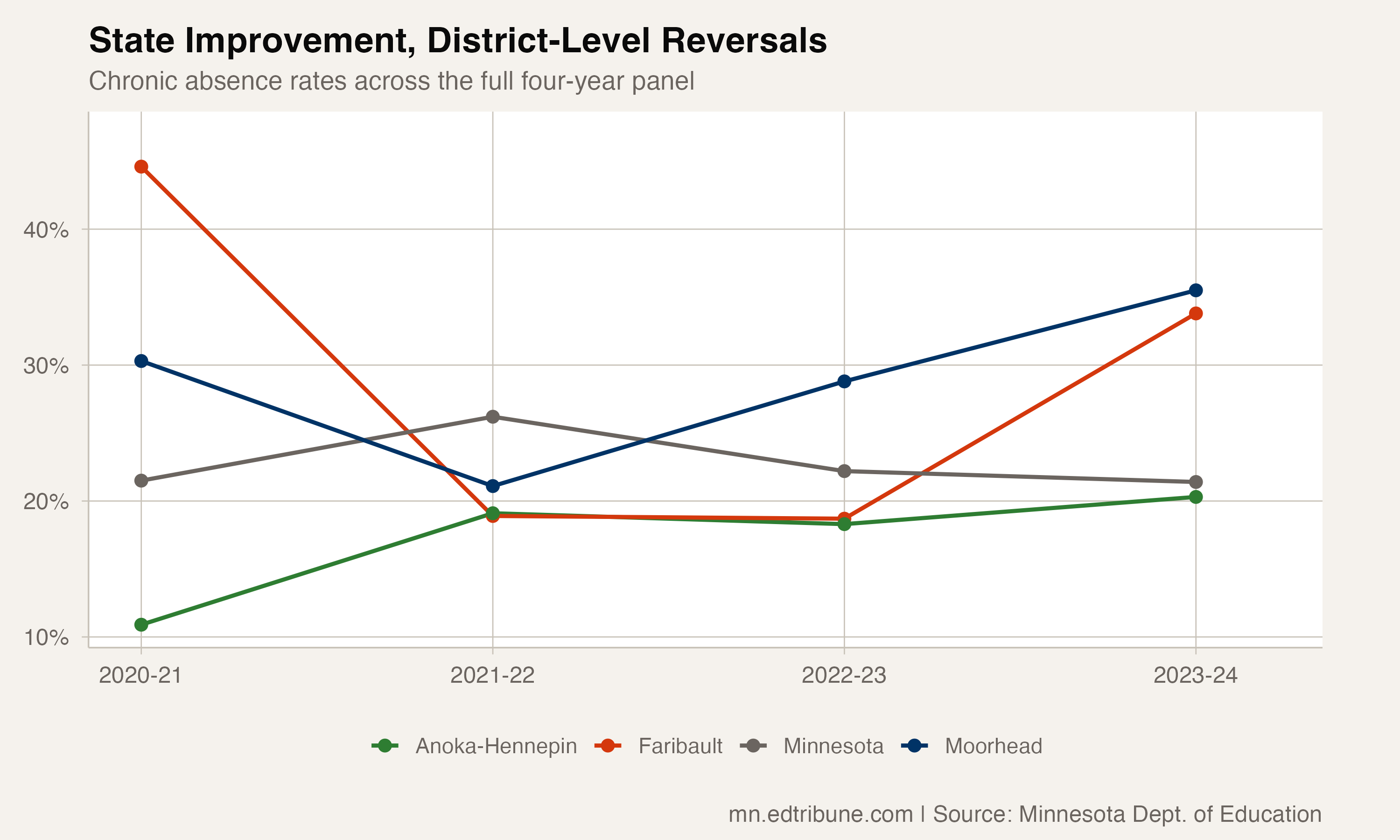
Minnesota's statewide chronic absence rate improved from 22.2% in 2022-23 to 21.4% in 2023-24, a change of 0.8 percentage points. The largest improvement in the four-year panel was four points the year before. At the same time, 28 of 295 strict four-year-panel districts reached their highest chronic-absence rate.
The contrast is visible in the state's largest district. Anoka-Hennepin↗ET enrolled 38,631 students in 2023-24 and recorded a 20.3% chronic-absence rate, up from 18.3% the year before. Its latest rate was the highest in the four-year panel. The district's 7,857 chronically absent students put a large system's local increase beside a statewide improvement.
Faribault's spike was large, but not a record
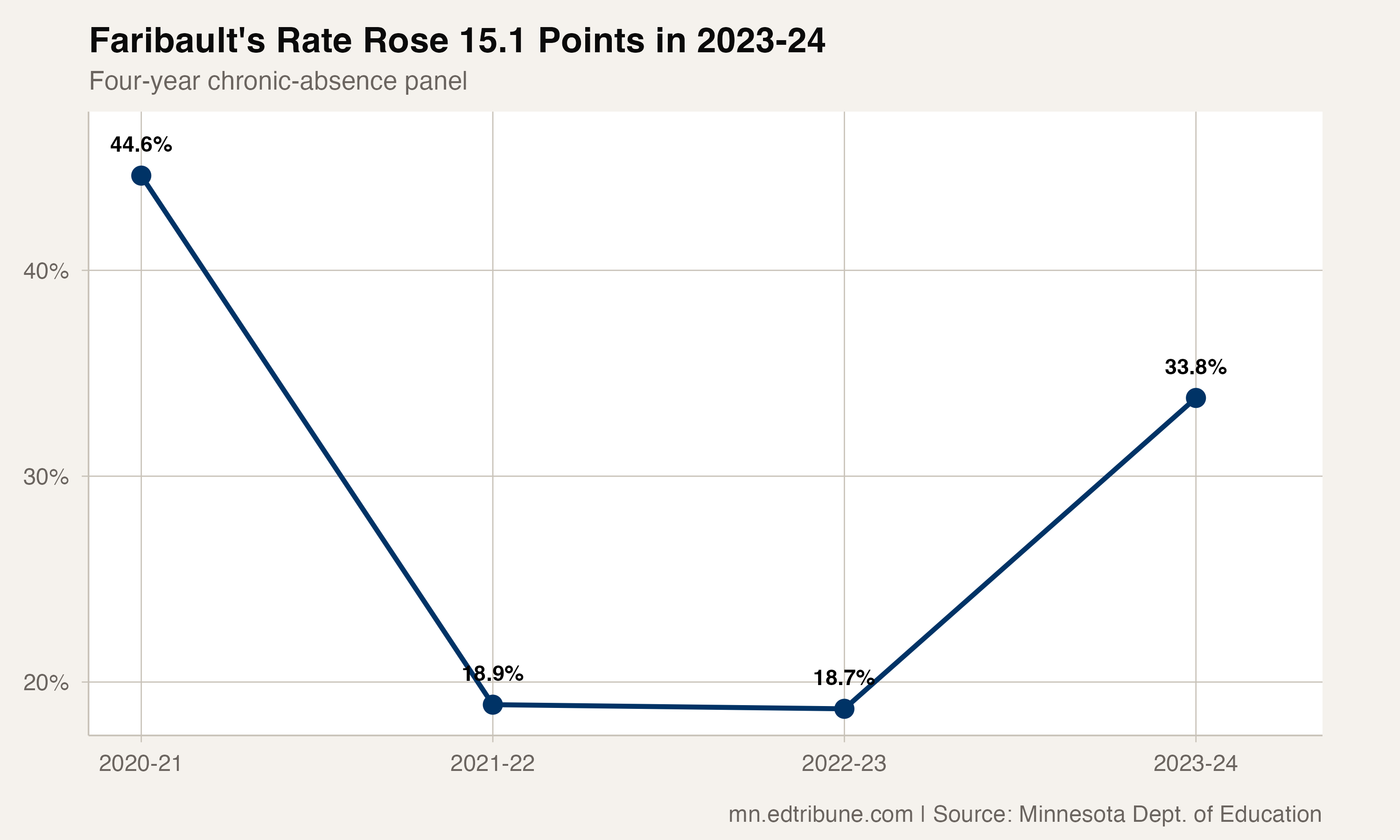
Faribault↗ET had the largest 2023-24 rate increase among districts with at least 500 students in that year. Its rate rose 15.1 percentage points, from 18.7% in 2022-23 to 33.8% in 2023-24. The number of chronically absent students rose by 431, from 618 to 1,049.
The full four-year record changes the interpretation. Faribault's rate was 44.6% in 2020-21, above its 2023-24 rate, so the latest spike was not an all-time high.
| School year | Chronic-absence rate | Chronically absent | Enrollment |
|---|---|---|---|
| 2020-21 | 44.6% | 1,498 | 3,358 |
| 2021-22 | 18.9% | 630 | 3,328 |
| 2022-23 | 18.7% | 618 | 3,312 |
| 2023-24 | 33.8% | 1,049 | 3,107 |
The pattern is a sharp rebound after two lower years, not a simple record-setting climb. The files do not identify whether reporting practices, attendance supports, enrollment composition or local conditions explain the change.
Moorhead improved once, then climbed
Moorhead Area↗ET reached 35.5% chronic absence in 2023-24, its highest rate in the four-year panel, with 7,460 enrolled students. The path was uneven: the rate moved from 30.3% in 2020-21 to 21.1% in 2021-22, then rose to 28.8% and 35.5% over the next two years. The increase from 2021-22 to 2023-24 was 14.4 percentage points.
Moorhead High School recorded a 65.4% chronic-absence rate, or 1,320 chronically absent students among 2,017 enrolled. That school-level figure shows why district averages can conceal very different experiences across campuses.
The district's trajectory is a two-year climb after an earlier improvement, not a worsening every year across the full panel. The distinction matters when a four-year record contains a large first-year change.
28 districts reached a four-year high
The 28 districts at a four-year high range from small systems to large suburban districts. Edina↗ET, for example, reached 19.0%, its highest rate in the panel. Anoka-Hennepin's rate also reached its panel maximum, while its enrollment made the change consequential in absolute terms.
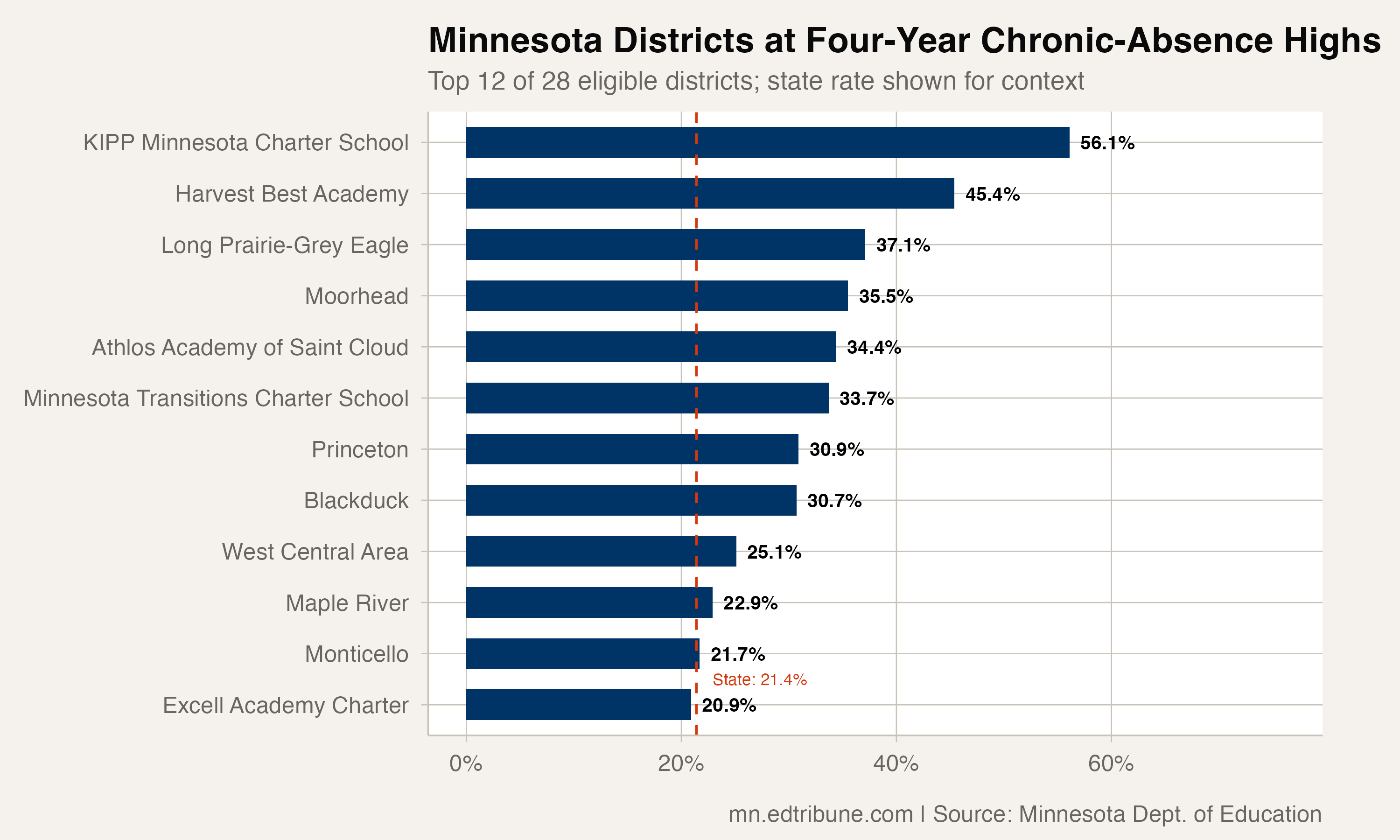
The comparison uses a minimum-size and data-coverage rule: a district must have at least 500 students in one available year and valid annual rates for all four available years. The designation is a rate maximum, not a claim that every district also had its highest raw count of chronically absent students.
What the data cannot explain
The attendance files show where rates changed and how those changes compare with the statewide path. They do not show why a particular district moved.
A change in reporting practice could raise a measured rate without a matching change in student behavior. Local conditions, enrollment composition, attendance supports and the pace of recovery could also matter. Those are competing explanations, not findings established by the enrollment and chronic-absence records.
What the data does establish is narrower and more useful: the state improved by 0.8 points in 2023-24, while 28 of 295 strict four-year-panel districts reached their highest rate. The next reporting cycle will show whether those district-level highs were one-year reversals or the start of longer patterns.
Chronic-absence and enrollment figures come from Minnesota Department of Education data files covering the 2020-21 through 2023-24 school years (Minnesota Department of Education).
Detailed code that reproduces the analysis and figures in this article is available exclusively to EdTribune subscribers.
Discussion
Sign in to join the discussion.
Loading comments...